
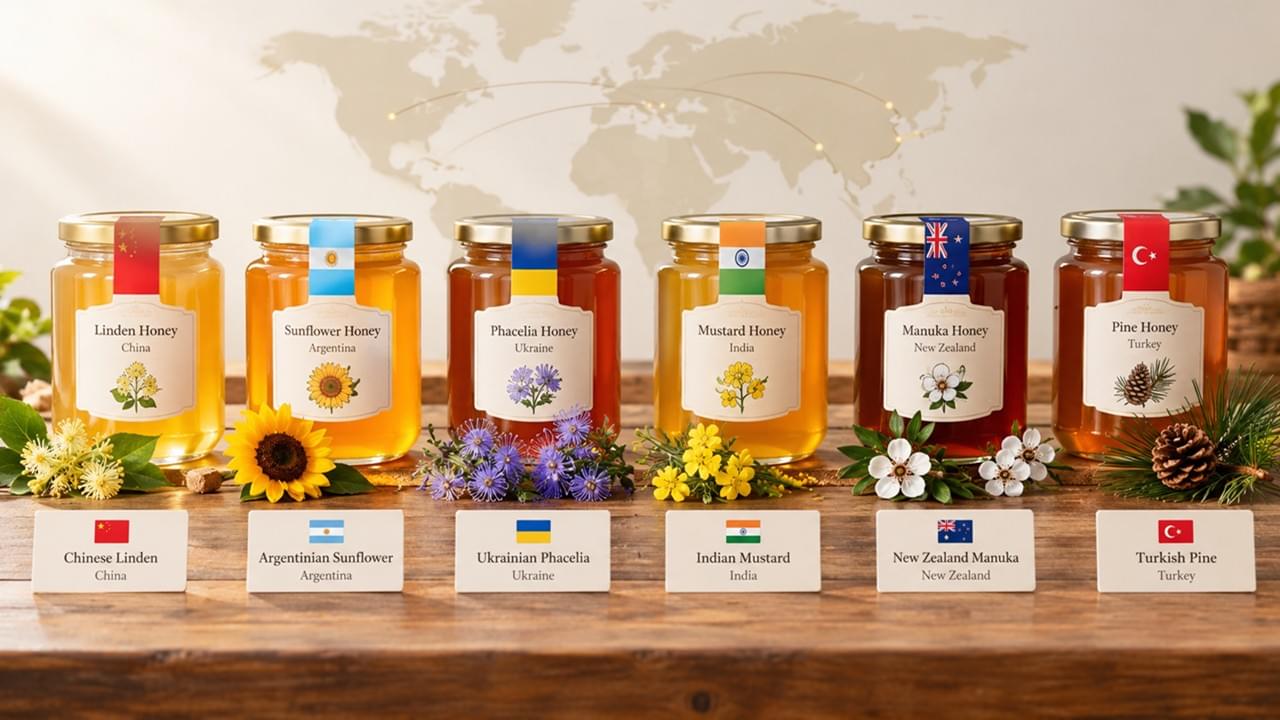
Ask ten procurement teams where their honey comes from and you’ll hear the same shortlist: China, Argentina, Ukraine, India, New Zealand, Turkey. But the real question was never which countries — it’s what each origin actually delivers once you look past the brochure. Origin decides your quality ceiling, your testing burden, your harvest calendar, and your price tier, all at once.
This is the working version of that bulk honey origin comparison — the one procurement teams keep open in a second tab. For the full sourcing framework, start with our Global Honey and Natural Sweetener Sourcing Guide.
Table of Contents
Toggle🌍 Why Origin Splits the World’s Honey Producing Countries Into Tiers
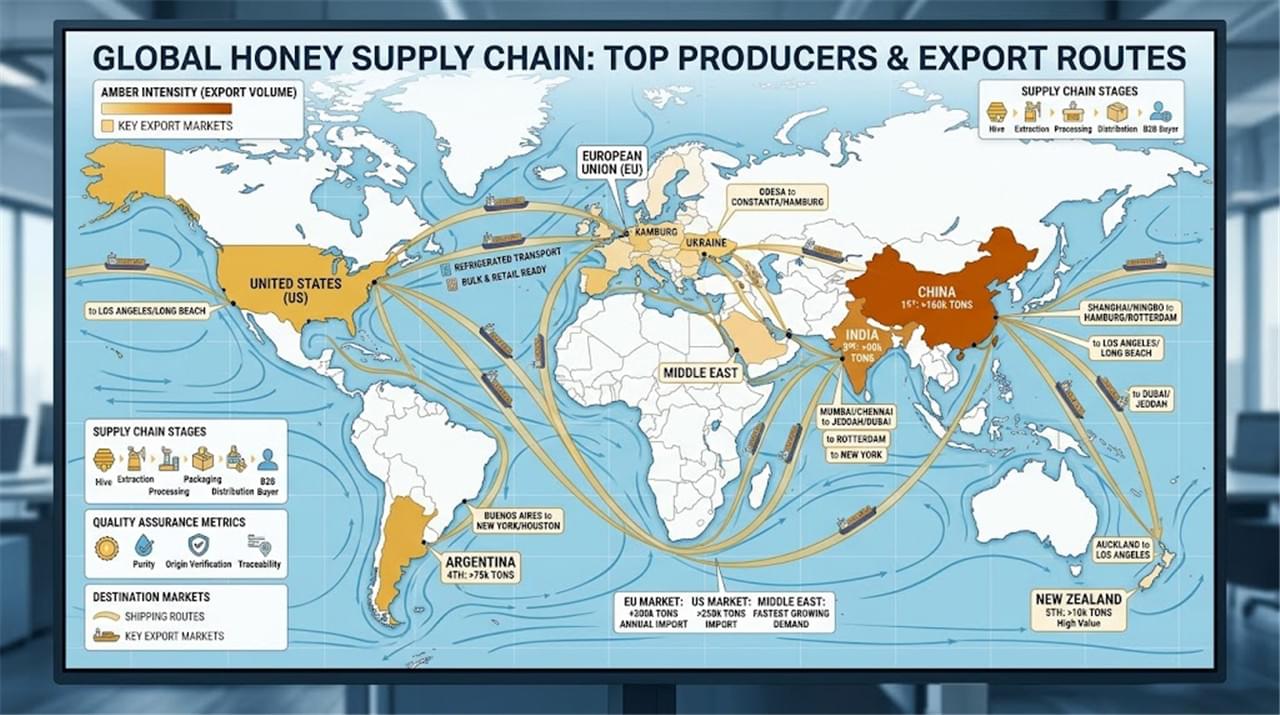
Two countries can harvest the same flower type and still land in different price tiers — because origin bundles together regulatory access, testing infrastructure, seasonal timing, and buyer perception. FAO data shows the top handful of honey producing countries account for well over half of global output, which means most of the world’s commercial honey moves through just six supply systems.
Know each system’s rules and you source faster and cheaper. Skip them, and you’ll pay for the gap somewhere — usually in a rejected container or a quiet reformulation.
🇨🇳 China: The Volume Engine Among Honey Producing Countries
Roughly 480,000 metric tons a year — about a quarter of everything the world produces. The varietal map is wide: linden and buckwheat up northeast, dark and distinctive jujube in the north, light rape and acacia in the east for mainstream commercial grades, and tropical lychee and longan in the south.
Here’s the part worth repeating: China honey quality spans the entire spectrum. The same country ships some of the world’s cleanest commodity honey and some product that fails panels. “China or not China” is the wrong question — the right one is whether your supplier survives independent testing. For EU and US export, that means a full antibiotic screen (chloramphenicol, nitrofurans, streptomycin) plus a pesticide multi-residue panel. The risk is real, not hypothetical, and it’s exactly why our adulteration testing standards page exists.
One more gate: every Chinese honey facility exporting must carry GACC registration. Ask for the registration number before you fall in love with a sample.
🇦🇷 Argentina: The Southern Hemisphere Sweet Spot
Around 73,000 tons annually, built on eucalyptus in the southeast, sunflower across Buenos Aires province, white clover in Patagonia, and pampas wildflower. Quality is consistently EU-compliant, backed by a mature export industry with established third-party testing infrastructure you can actually plug into.
As an Argentina honey supplier, the country’s real edge is the calendar: the December–April harvest lands exactly when northern hemisphere stock runs thin. If your production schedule peaks mid-year, this is your counter-seasonal hedge.
The catch is currency. Peso devaluation makes pricing lurch, so forward contracts should spell out currency terms in writing — an Argentine quote from January and the same quote from June can be two different businesses.
🇺🇦 Ukraine: EU-Grade Quality in a Complicated Present
Before 2022, Ukraine produced roughly 68,000 tons — sunflower honey around 60% of it, alongside phacelia, rape, linden, and acacia — with an excellent EU compliance record and a strong reputation in European markets.
The conflict disrupted production and logistics; some regions are inaccessible, others keep shipping. Treat “Ukraine” as a supplier-by-supplier question now, not a country-level answer. Verify current availability and routing directly.
Where legitimate suppliers remain qualified, the product merits serious consideration — and for some buyers, the sourcing decision carries genuine positioning value beyond the drum itself.
🇮🇳 India: Real Volume, Real Diligence
About 65,000 tons a year and the largest US import origin by volume. Mustard is the commercial workhorse, with eucalyptus, litchi, sunflower, and wildflower behind it.
The honest history: US markets have documented adulteration issues with India-origin commodity honey. That doesn’t condemn the origin — premium Indian suppliers produce genuinely clean product — but it does mean supplier qualification matters more here than almost anywhere else. Long track records, transparent documentation, and independent testing aren’t nice-to-haves at this origin; they’re the entire selection process.
🇳🇿 New Zealand: Manuka Honey Sourcing at the Premium End
Small by volume — around 20,000 tons total, roughly half of it Manuka — but untouchable at the top of the price ladder. Manuka is the world’s most valuable honey by unit, and New Zealand protects that value with the strictest regime in the category: the Ministry for Primary Industries requires every export labeled “Manuka” to pass its 4-compound plus DNA test. The independent UMF grading system adds another layer, tying ratings to antibacterial activity.
Why the security? Because fraud is industrial-scale — more Manuka is sold worldwide than New Zealand could ever produce. For Manuka honey sourcing, MPI-verified exporters only. Beyond Manuka, the country’s clover, thyme, and kamahi honeys offer genuine provenance at far gentler prices.
🇹🇷 Turkey: The Pine Honeydew Original
Second-largest producer globally at around 115,000 tons, and home to a product that exists nowhere else: pine honeydew, harvested from insect secretions in Pinus brutia forests rather than flower nectar. Dark, resinous, lower in sugar — and building a real premium following in the EU. Chestnut and flower honeys round out the offer.
Quality runs the usual spectrum: strong, reputable exporters alongside operations you’d rather not meet. Documentation review and standard testing apply here like anywhere.
📊 Honey Producing Countries Compared: The Buying Summary
| Origin | Volume | EU Access | Testing Priority | Quality Ceiling | Price Tier |
|---|---|---|---|---|---|
| China | Highest | GACC required | Very high | High | Low–medium |
| Argentina | High | Direct | Standard | High | Medium |
| Ukraine | Medium | Direct | Standard | Very high | Medium |
| India | High | Direct | Very high | High | Low–medium |
| New Zealand | Low | Direct | High (Manuka fraud) | Highest | Premium |
| Turkey | High | Direct | Standard | Medium–high | Medium |
Reading the table top to bottom, one pattern stands out: testing priority tracks risk, not reputation. The origins demanding the heaviest verification are the ones that also offer the best value at scale — which is precisely why disciplined buyers don’t avoid them, they instrument them. For where demand across these origins is heading, see our Global Market Trends analysis; for the certification layer each origin must satisfy, the Quality Standards and Certifications guide covers it in depth.
🧭 Final Word: Matching Origin Across the Honey Producing Countries
There is no single “best” origin — only the right match for your spec, season, and claim. Commodity volume with value pricing points to China or India with rigorous independent testing. Counter-seasonal supply and frictionless EU access point to Argentina. Premium functional claims point to New Zealand — verified. Something distinctive for a specialty line points to Turkey’s pine honeydew.
Get the origin decision right across the world’s major honey producing countries and everything downstream — testing budget, contract terms, launch calendar — gets easier. Our sourcing team works with qualified suppliers across all six origins.
 English
 Arabic
 French
 German
 Portuguese
 Russian
 Spanish
 Japanese
 Korean