
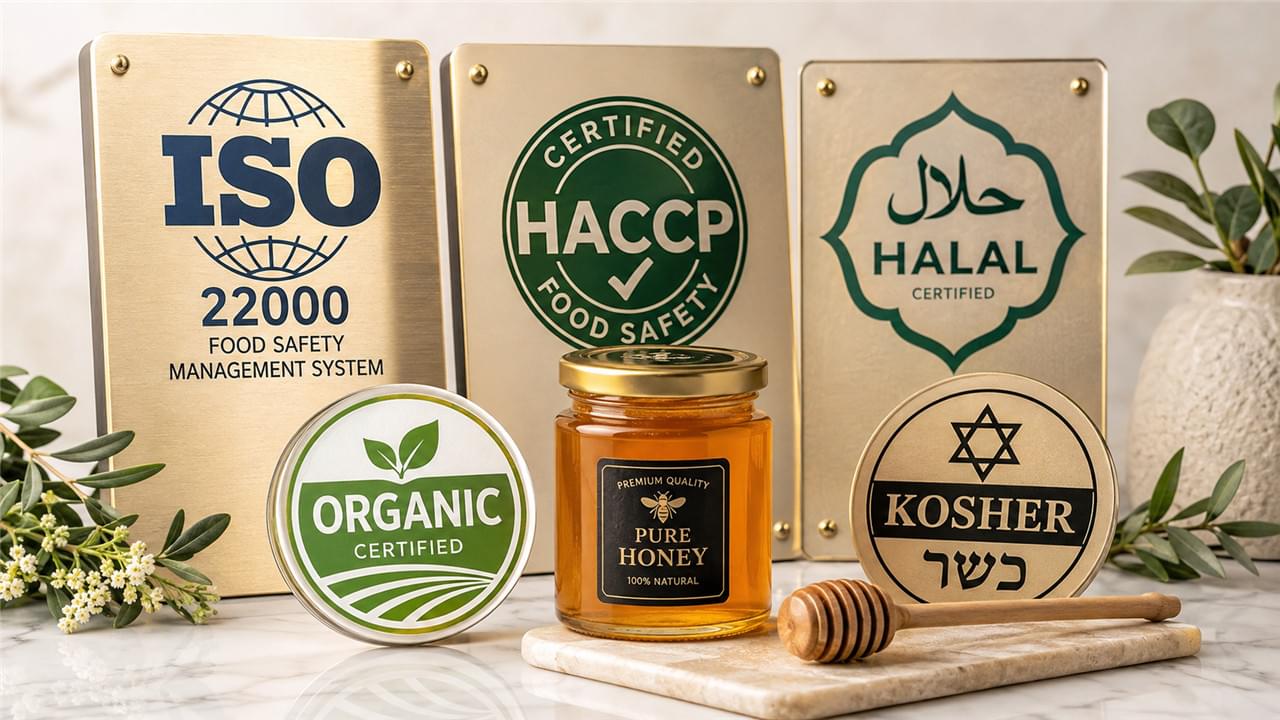
Certification is procurement shorthand — a verified signal that a supplier runs specific systems and meets specific standards. The hard part for B2B buyers is sorting that signal from the noise: legally mandated requirements, commercially expected credentials, and certifications that are largely decorative.
Honey, syrups, and other natural sweeteners sit in a tricky spot — single-ingredient products with a long adulteration history, patchwork regional rules, and a retail environment where “certified” sells. This guide walks through the full framework of natural sweetener quality standards: food safety systems, Codex, regional regulation, commercial certifications, and the testing that proves the product is what the paperwork claims.
⭐ Why Natural Sweetener Quality Standards Matter
Certifications exist so you can delegate due diligence: a third party has checked the systems, so you don’t audit every supplier from scratch. They don’t tell you which credentials matter in which market — that’s still your job.
Sort certificates into three buckets first — legally mandated (required to sell at all: EU regulation, FDA/FSMA, GACC registration), commercially expected (demanded by customer supplier codes even where the law doesn’t require them, e.g. GFSI-benchmarked certification), and meaningful vs performative (changes how the product is made, or just decorates the certificate). Keep that model and the rest of this guide sorts itself out.
🛡️ Food Safety Management Standards
ISO 22000: The International Baseline
ISO 22000 is the international standard for food safety management systems, folding HACCP into a broader auditable framework — and for most natural sweetener quality standards programs it’s the anchor certificate. A supplier’s certificate means a third party verified the system: hazard identification, critical control points, corrective action. That buys audit-ready documentation and a credential most retail and manufacturer supplier codes accept.
Certificates run on a three-year cycle with annual surveillance audits, and they expire — verify current validity against the certification body’s database rather than trusting the paper copy.
HACCP: The Foundational Protocol
HACCP sits underneath ISO 22000 and is a market-access requirement on its own. The documentation is what separates a real system from a sticker on the wall:
- HACCP plan summary (without proprietary detail)
- Critical control point (CCP) list and monitoring records
- Corrective action log
- Verification activities record
Buyers sourcing honey routinely start with honey HACCP certification because it underpins access almost everywhere — a supplier that hands over clean CCP records has done the actual work, not just the paperwork.
FSSC 22000 and the GFSI Benchmark
FSSC 22000 layers additional technical requirements on top of ISO 22000 and, crucially, carries recognition from the Global Food Safety Initiative — the GFSI Global Food Safety Initiative benchmark large retailers work against. Walmart, Tesco, and Carrefour expect GFSI-recognized suppliers; in this supply chain you’ll most often see FSSC 22000, BRC Food Safety, and IFS Food. Big-box retail is the line between “qualified” and “not invited.”
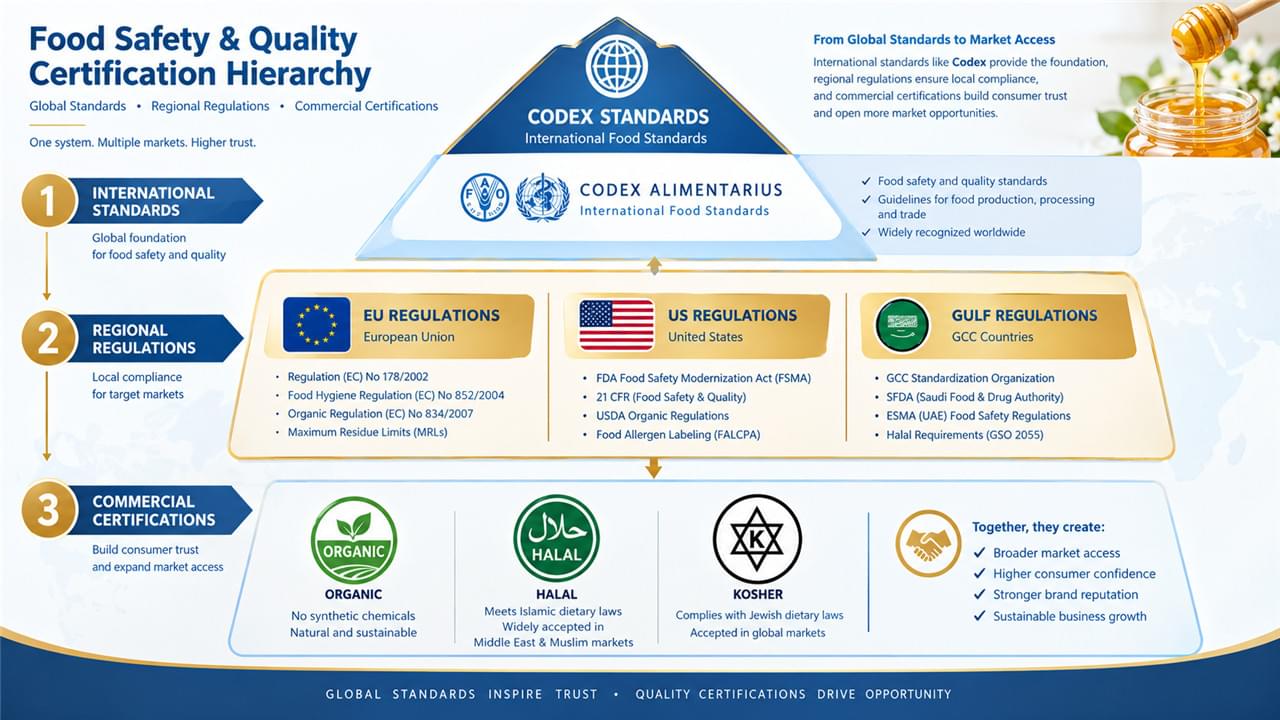
🌐 Codex Alimentarius: The Global Baseline
The Codex Alimentarius Commission (FAO/WHO) sets the international reference standards that national regulations start from. For honey, that’s CODEX STAN 12-1981 (revised) — parameters buyers should know cold:
| Parameter | Codex Limit | Notes |
|---|---|---|
| Moisture content | ≤20% | Premium grades require ≤18% |
| Fructose + glucose | ≥60% (blossom); ≥45% (honeydew) | Purity indicator |
| Sucrose | ≤5% (most varieties) | Higher sucrose hints at adulteration |
| HMF | ≤40 mg/kg | Heat damage indicator |
| Free acidity | ≤50 mEq/kg | Natural acidity |
| Diastase | ≥8 Schade | Enzyme activity / processing indicator |
The Codex baseline anchors most natural sweetener quality standards worldwide, and markets only add on top of it. The current text lives in the Codex Alimentarius honey standard; most regional disputes trace back to these six numbers.
🗺️ Regional Natural Sweetener Quality Standards
This is where natural sweetener quality standards get real, because regional requirements diverge sharply.
🇪🇺 European Union
The EU Honey Directive (2001/110/EC, amended by 2014/63/EU) drives labeling more than composition: country-of-origin labeling is mandatory, blends must list every source country (or the “blend of EU/non-EU honey” wording), and filtered honey carries its own rules. Regulation (EC) 1881/2006 sets the contamination limits for pesticides, heavy metals, and aflatoxins (full text: EU Honey Directive 2001/110/EC). Chinese exporters also need GACC registration (facilities are listed publicly).
🇺🇸 United States (FDA/USDA)
The US approach is built around the Food Safety Modernization Act: foreign suppliers must meet FSMA requirements, and importers carry the verification burden through the Foreign Supplier Verification Program — if your supplier falls short, the importing side owns the problem. Add FDA facility registration and prior notice per shipment. USDA honey grading (Grade A/B/C) is voluntary but a useful shorthand.
🇸🇦 Gulf and Middle East
The Gulf states run on a Codex-plus-HALAL model: HALAL certification is effectively mandatory for honey in GCC markets, the GSO honey standard builds on Codex, and imports need a health certificate from an accredited authority. Supplying Gulf buyers? HALAL is a gate, not a garnish.
🏅 Commercial Certifications: Market Access and Premium Positioning
Beyond the mandatory layer, three certifications decide whether you’re in the running in certain channels — and how much shelf premium you can charge. This is the commercial layer that goes beyond minimum natural sweetener quality standards.
✅ HALAL Certification
HALAL is a legal requirement in GCC markets and parts of Southeast Asia (Malaysia, Indonesia), and a commercial edge wherever Muslim consumers are a segment. What it requires of a facility:
- No prohibited substances in processing
- No cross-contamination with non-HALAL products
- Cleaning and sanitization without alcohol-based agents
- Chain-of-custody documentation from farm to package
- Annual third-party audit by a recognized body
The catch is recognition: JAKIM (Malaysia), BPJPH (Indonesia), ESMA (UAE), and SASO (Saudi Arabia) each recognize specific certifiers, and a certificate from one may carry no weight in another. If you need a HALAL certified honey supplier, confirm the certifying body’s standing in your destination market before negotiating.
🌱 Organic Certification
Organic adds a farm-level layer most certifications skip:
| Standard | Market | Farm Requirements | Processing Requirements |
|---|---|---|---|
| USDA NOP | United States | Foraging zone organic; no prohibited substances | Certified organic handling |
| EU Organic (EC 848/2018) | European Union | Full certification chain | Certified organic processing |
| JAS Organic | Japan | JAS requirements | Separate handling |
| Canada Organic | Canada | COR certification | Certified facilities |
Recognition varies: the EU and Canada have mutual recognition, but US NOP and EU Organic are not automatically equivalent — check current status. The organic sweetener certification path usually starts with whichever scheme your biggest market recognizes.
📜 Kosher Certification
Kosher matters for Jewish-market segments in the US, Israel, and Europe. Honey is inherently kosher (pareve), so the certification is really about the facility — no non-kosher processing aids, no cross-contamination. Agencies to know: OU (Orthodox Union), KOF-K, Star-K, and cRc, with OU the most widely recognized internationally.
🧪 Testing and Verification: Beyond Natural Sweetener Quality Standards
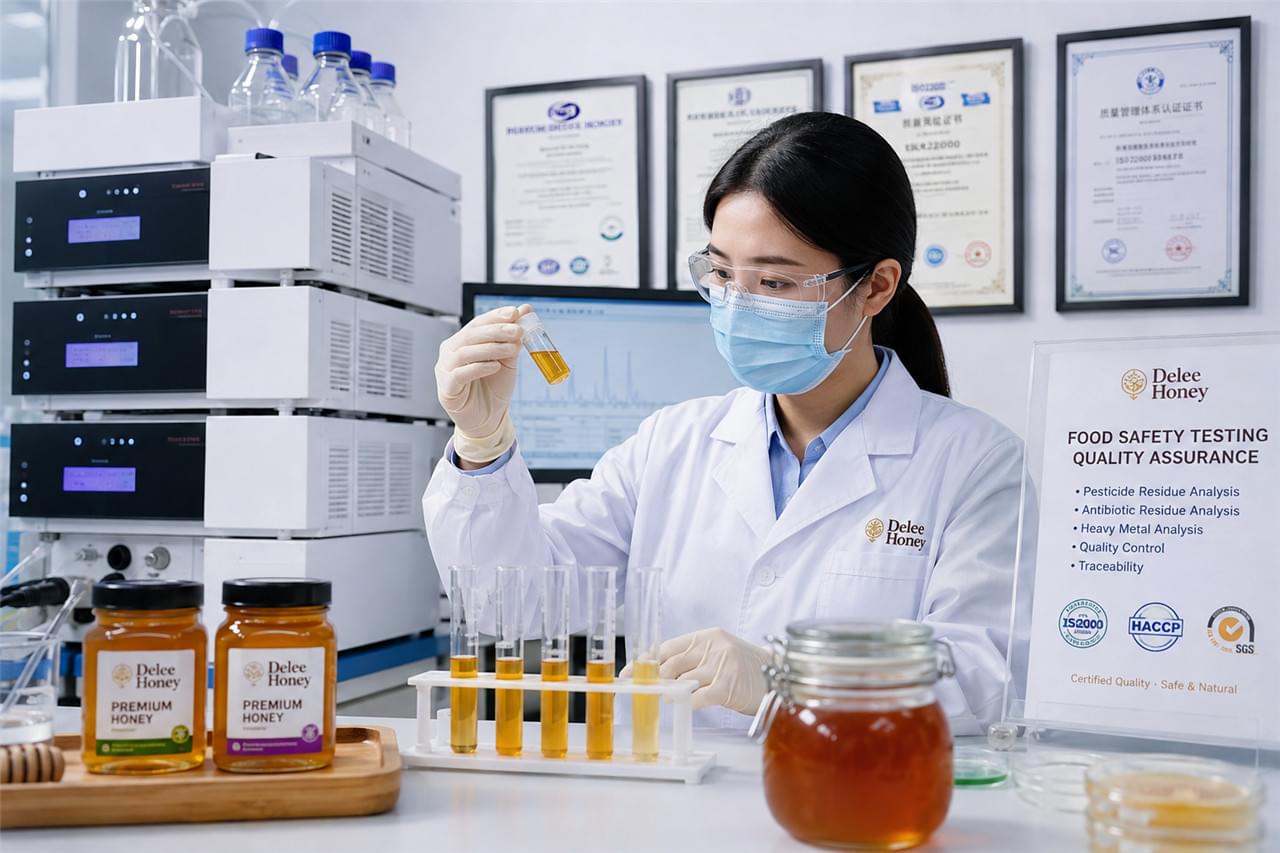
Certifications verify systems; testing verifies product. A certificate says a system exists; a lab report says the honey in that container is what the label claims — both belong in any complete natural sweetener quality standards program.
🔬 The Essential Testing Panel
| Test | Method | Purpose | Frequency |
|---|---|---|---|
| Moisture/Brix | Refractometry | Grade confirmation | Every lot |
| HMF | HPLC | Heat damage / freshness | Every lot |
| Diastase | Phadebas | Processing indicator | Every lot |
| C4 sugar adulteration | IRMS | Cane/corn syrup detection | New supplier; periodic |
| NMR metabolomics | NMR | C3 syrup adulteration (rice, beet) | Periodic |
| Pesticide multi-residue | GCMS/LCMS | Residue compliance | Every lot (export) |
| Antibiotic residues | ELISA/HPLC | Country-specific requirements | EU, US exports |
| Heavy metals | ICP-MS | Safety / regulatory | Regular |
| Pollen analysis | Melissopalynology | Origin verification | New supplier |
Run the adulteration tests on every new supplier, keep the routine panel per lot, and treat pollen analysis as the origin check. For method-level detail, our Ensuring Honey Quality – Adulteration Testing page goes deep.
📋 Building a Compliance File for Natural Sweetener Quality Standards
A qualification package that protects you contains more than certificates. Work from this checklist when assembling natural sweetener quality standards documentation:
- Current ISO/FSSC 22000 certificate — verified against the certifier’s database
- HACCP plan summary
- Current HALAL/Organic/Kosher certificates as applicable
- Last three Certificates of Analysis from commercial lots
- Third-party lab reports (pesticide, antibiotic, adulteration)
- Facility audit report (third-party or self-assessment)
- Traceability documentation sample
Suppliers who hand this over without being chased are the ones worth keeping. For sourcing context, see our Global Honey Sourcing Guide; for the product side, the Honey Varieties Production Guide and Natural Syrups and Sweeteners Guide; and organic buyers should check our Sustainability and Ethical Sourcing page.
That’s the full picture of natural sweetener quality standards for honey and syrups — and the documentation package that proves you’ve done the work.

 English
 Arabic
 French
 German
 Portuguese
 Russian
 Spanish
 Japanese
 Korean