
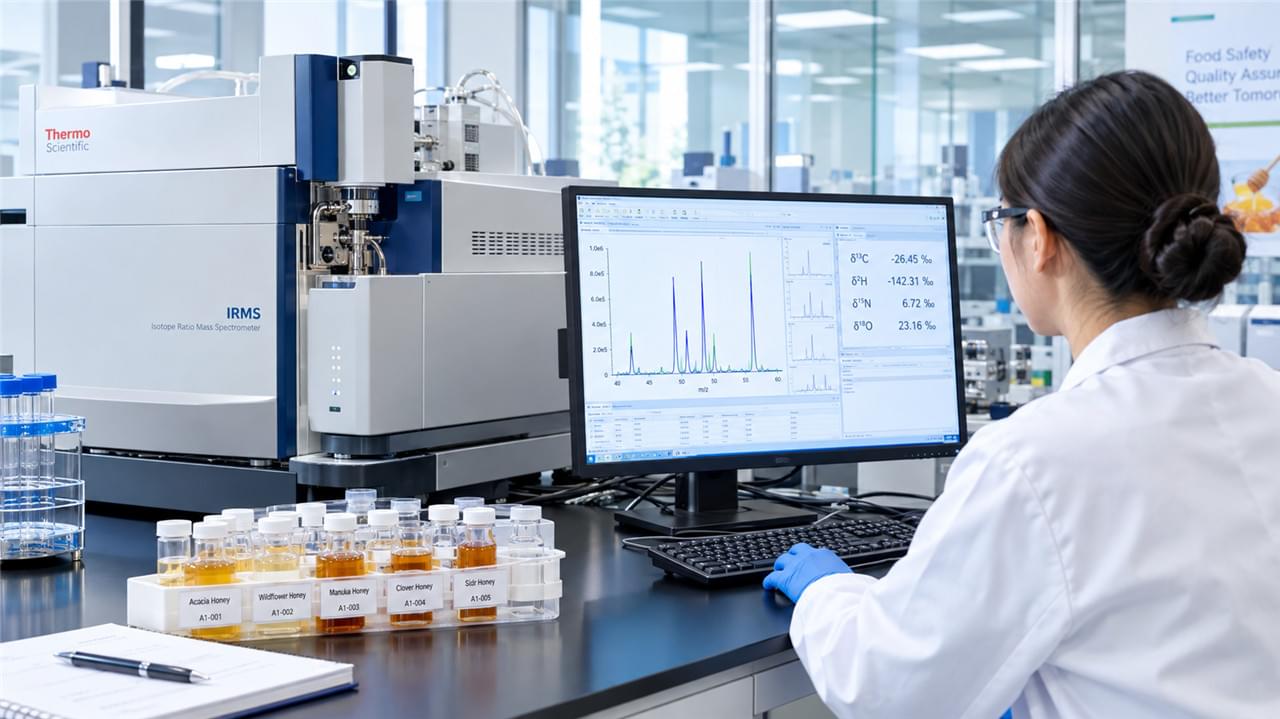
Adulteration in natural sweeteners isn’t a fringe risk — it’s a systematic commercial threat, with billions of dollars of fraudulent product entering global supply chains every year. For B2B buyers the fallout ranges from regulatory non-compliance and recalls to reputational damage and retailer delisting. A structured program of natural sweetener adulteration testing and supplier qualification isn’t optional for serious procurement teams. It’s the cost of doing business — and it’s cheaper than the alternative.
⭐ The economics explain everything: bulk honey sells at 3–8/kgwhilethesyrupsusedtocutitcost3–8/kgwhilethesyrupsusedtocutitcost0.50–1.50/kg. Every testing dollar you spend is defending a 5x price gap — the exact gap natural sweetener adulteration testing exists to protect.
Why Natural Sweetener Adulteration Testing Pays for Itself
The incentive is structural, not opportunistic. Even 20% adulteration with low-cost syrup yields a substantial margin on volume, and modern techniques are engineered to defeat visual inspection and basic chemistry. That’s precisely why natural sweetener adulteration testing has become laboratory work — the Joint FAO/WHO work on honey adulteration tracks how sophisticated the problem has grown.
| Sweetener | Adulteration Method | Detectability |
|---|---|---|
| Honey | C4 sugar addition (corn/cane syrup) | IRMS detects ≥7% |
| Honey | C3 syrup addition (rice, beet syrup) | NMR metabolomics; specific enzyme tests |
| Honey | Water addition | Refractometry (moisture testing) |
| Honey | Geographic origin fraud | Pollen analysis; trace element profiling |
| Maple syrup | Added sucrose solution | HPLC sugar profile; C13 isotope |
| Organic honey | Conventional honey mislabeled | Supply chain documentation; residue testing |
| Premium honey | Grade substitution (cheaper origin) | Pollen analysis; NMR |
The table above is the map. The three tiers below are the response — testing scaled to the risk each method actually carries.

Three Tiers of Natural Sweetener Adulteration Testing
Effective natural sweetener adulteration testing layers three tiers: cheap screens on every lot, expensive forensics where risk justifies them, and safety panels for market compliance.
Tier 1: Basic Quality and Purity (Every Lot)
Refractometry (moisture/Brix) — a digital refractometer, handheld or bench-top, at very low cost. It catches water addition and off-spec moisture instantly. It won’t catch most adulteration methods, but it’s the fastest gate you have.
HPLC sugar profile — moderate cost. Verifies sucrose content, the fructose:glucose ratio, and basic sugar composition. The limitation is worth remembering: C3 syrups share the same sugar types as honey, so this test can’t see them.
Tier 2: Adulteration Screening (New Suppliers, Periodic)
IRMS — C4 sugar detection — the honey adulteration IRMS test measures carbon-13 isotope ratios (~$150–250/sample) and catches cane sugar and corn syrup addition at ≥7%. It does NOT detect C3 syrups: rice, beet, and wheat share honey’s isotope profile. Every qualified supplier should provide current IRMS reports — commission your own for new suppliers.
NMR metabolomics — NMR honey authentication (~$200–400/sample) compares spectra against reference databases and catches exactly what IRMS misses: C3 syrups, geographic origin fraud, and subtle formula manipulation. It’s rapidly becoming the gold standard for comprehensive honey authentication; the EU reference laboratory’s NMR methodology is the technical backbone. Several accredited labs now offer the service.
Pollen analysis (melissopalynology) — moderate cost. Microscopic pollen identification exposes geographic origin fraud, wrong monofloral claims, and ultra-fine filtration that stripped the pollen out entirely.
Tier 3: Safety Testing (Export Compliance)
Pesticide multi-residue panel — LC-MS/MS and GC-MS/MS across 200–400+ compounds depending on destination market. EU export requires the full EU MRL panel; US shipments typically apply the EU panel as a conservative benchmark. Every export lot to regulated markets.
Antibiotic residues — chloramphenicol, nitrofuran metabolites, streptomycin, oxytetracycline. EU/US/Japan apply zero tolerance or near-zero action levels; test every lot from high-risk origins.
Heavy metals (ICP-MS) — lead, cadmium, arsenic, mercury. All major export markets set limits. Test per shipment, or at minimum during qualification.
Supplier Qualification: Putting Natural Sweetener Adulteration Testing to Work
Tests only protect you if they’re wired into a repeatable process. A four-phase sweetener supplier qualification protocol looks like this:
Phase 1 — Document review:
- ISO 22000/FSSC certificate (verify against the certification body’s database)
- HACCP CCP summary
- Last 6 months of production CoAs
- Third-party pesticide and adulteration test reports
Phase 2 — Independent sample testing:
- IRMS test on supplier samples
- Pesticide multi-residue panel
- Antibiotic residue panel (for honey)
- Pollen analysis if origin claims matter
Phase 3 — On-site or third-party audit:
- Facility inspection against ISO 22000/GMP standards
- Raw material intake records review
- Production batch record review
- Laboratory equipment calibration review
Phase 4 — Ongoing monitoring:
- Per-lot CoA requirement
- Annual independent testing
- Periodic re-qualification audit
Building a Natural Sweetener Adulteration Testing Program That Lasts
Phase 2 is where buyers separate robust suppliers from lucky ones — a supplier whose paperwork is flawless but who flinches at independent IRMS testing is telling you something. Of all the natural sweetener adulteration testing steps, independent verification earns its cost fastest. For supply chain integrity documentation on Delimfg’s products, our quality team provides complete testing documentation packages. Build the bigger picture with our Quality Standards and Certifications Guide, the lab-level detail in Ensuring Honey Quality and Adulteration Testing, the legal baselines in the Global Standards Codex EU USDA comparison, and origin context in the Global Honey Sourcing Guide.
Request full testing documentation for supplier qualification


 English
 Arabic
 French
 German
 Portuguese
 Russian
 Spanish
 Japanese
 Korean