
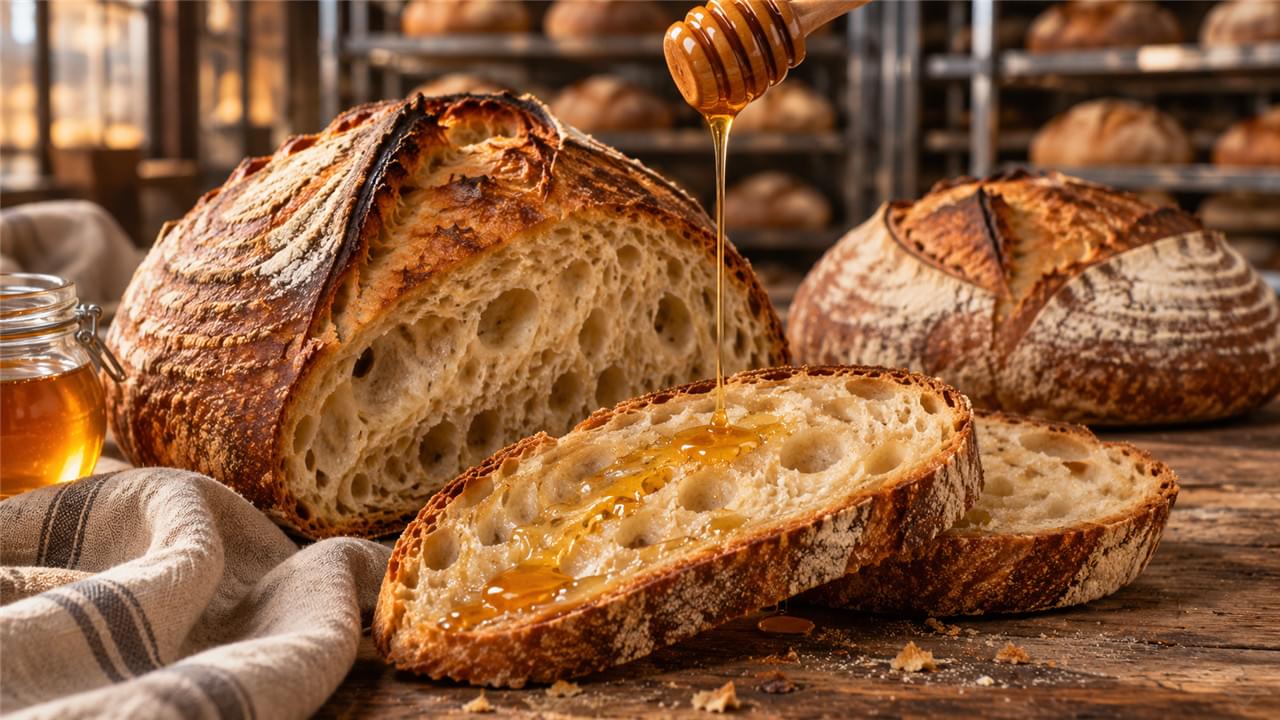
Swapping sucrose for natural sweeteners in bakery and confectionery is where product development earns its keep — and where most reformulation projects quietly fail. Honey, maple syrup, agave, and coconut sugar don’t behave like sucrose on any dimension that matters: moisture, browning, crystallization, flavor. Master those differences and the launch scales. Ignore them and you’ll meet them again at the oven, on the shelf, or in a customer complaint.
This guide lays out the working rules of bakery sweetener formulation for R&D teams and production bakers — with the compensation numbers you can take straight to a bench trial.
⭐ The short version: six rules decide everything — water balance, browning control, yeast tolerance, texture targeting, leavening chemistry, and shelf-life packaging. Miss one and it picks your batch for you.
⚖️ Rule 1: Compensate the Water — Bakery Sweetener Formulation 101
Liquid sweeteners carry free water into dough and batter, and the dough doesn’t forgive. Skip the compensation and you get over-wet doughs, spreading cookies, and collapsed cake structures. These are the working numbers of bakery sweetener formulation:
| Sweetener | Water Content | Reduction in Formula Water |
|---|---|---|
| Honey | 17–20% | 15–18% of honey weight |
| Maple Syrup | 33–35% | 30–33% of syrup weight |
| Agave Nectar | 20–25% | 18–22% of nectar weight |
| Molasses | 20–25% | 18–22% of molasses weight |
Maple’s numbers surprise people every time — at 33–35% water it’s closer to a flavored liquid than a sweetener, and the formula has to treat it that way.
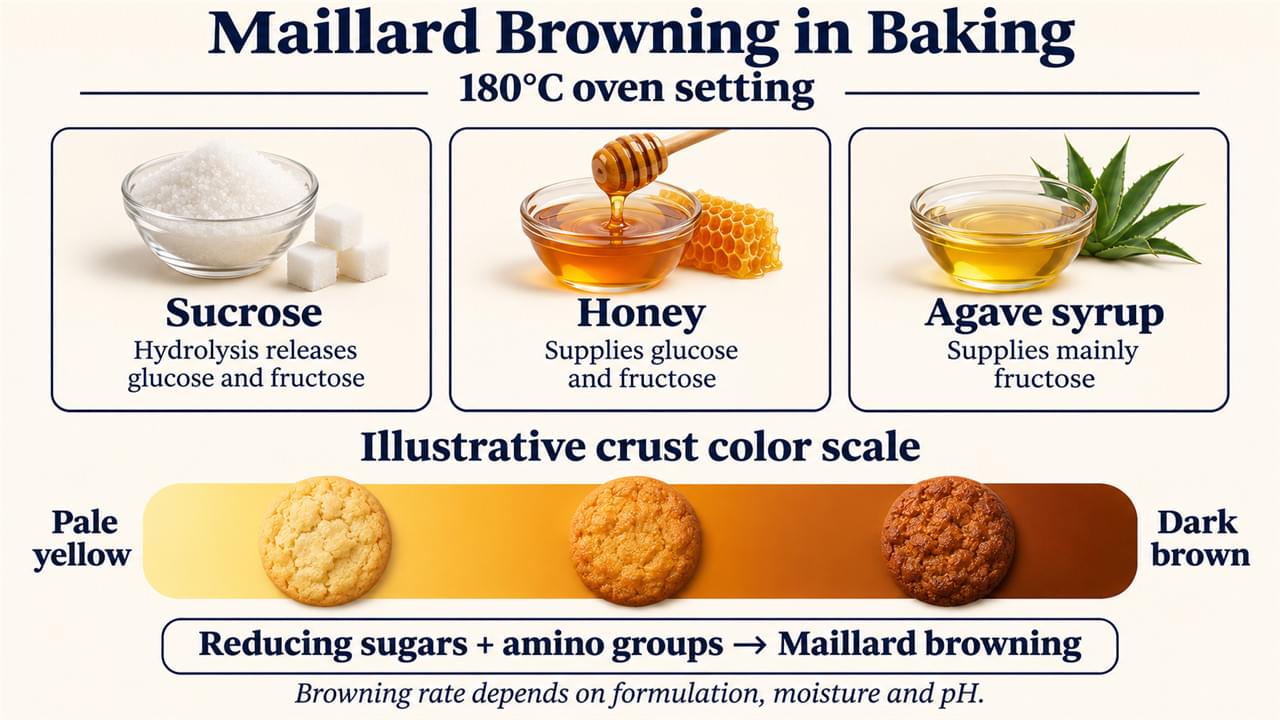
🔥 Rule 2: Master Honey Maillard Browning Control
Fructose reacts with amino acids roughly 7–8× faster than glucose, and both outrun sucrose. Fructose-rich sweeteners — honey, agave — therefore brown earlier and darker than your current spec expects, and honey Maillard browning control is mostly about heat and blending:
- Lower oven temperature by 10–15°C and extend baking time to match
- Tent foil or drop the rack position in batch ovens where top-wall heat runs hot
- Blend with low-fructose sweeteners — coconut sugar, maple syrup — to moderate browning intensity
Watch color, not the clock. The clock lies when the temperature changes.
🍞 Rule 3: Respect Honey’s Antimicrobials in Yeasted Doughs
Honey has leavened bread for centuries, but industrial scale changes the math. Its antimicrobial compounds — hydrogen peroxide, methylglyoxal in manuka-type varieties, defensin-1 — inhibit yeast at concentration, which makes dosing the central decision in yeasted bakery sweetener formulation:
- ≤3% honey by flour weight: no significant yeast inhibition
- 3–6%: slight slowdown; extend proof time by 10–15 minutes
8%: significant inhibition — switch to osmotolerant yeast strains or reformulate
At controlled levels, the benefits stack nicely: better crust color and gloss, extended crumb softness from hygroscopicity, and a subtle floral note. For choosing which honey to run, see our guide to selecting the right honey variety for baking.
Maple syrup suits whole grain and multigrain breads, where a bold sweetener voice would be wrong. At 2–4% by flour weight there’s no meaningful fermentation impact — just mild caramel and lower sweetness (0.6–0.9× sucrose).
🍪 Rule 4: Texture Targeting in Bakery Sweetener Formulation
Cookie texture is governed by the ratio of hygroscopic to non-hygroscopic sweeteners — a clean label bakery sweetener strategy is really a texture map:
| Desired Texture | Sweetener Strategy |
|---|---|
| Soft, chewy cookie | 50–100% honey or agave replacement |
| Crispy, snap cookie | Coconut sugar or maple syrup; minimize liquid sweeteners |
| Semi-soft | Blend: 40% honey + 60% coconut sugar |
| Crinkle-style | Honey 30% + sucrose 70%; high fructose promotes surface cracking |
The coconut sugar cookie substitution deserves special mention: at 1:1 for brown sugar it delivers mild caramel at slightly lower sweetness while keeping the snap intact. Details in our coconut sugar applications guide.
🌾 Gluten-Free Cookie Applications
In gluten-free formulas, structure comes from starches, not gluten networks — so moisture retention is everything. Honey and agave act as functional binders here, often replacing hydrocolloids (guar, xanthan) outright:
- Replace 60–80% of crystalline sugar with honey or agave
- Reduce starch by 5–8% to compensate for the added moisture
- Chill dough 30–60 minutes before baking to firm the texture
🎂 Rule 5: Leavening Balance in Bakery Sweetener Formulation
Honey is slightly acidic (pH 3.5–4.5), and baking soda notices. In cake formulas using soda, that acidity can react prematurely or tip the leavening balance. Two fixes: add ¼ tsp baking soda per 250 g honey to neutralize, or switch to buffered baking powder and skip the adjustment entirely. Honey’s emulsifying proteins also help air incorporation in creamed mixtures — slightly finer crumb, no fat or egg changes needed below 50% substitution.
🍬 Rule 6: Confectionery Is Where Honey Earns Its Premium
🍯 Caramels and Toffees
Honey’s invert sugar fraction (free glucose + fructose) is a first-class anti-crystallization agent. In caramels it prevents the graining that plagues high-sucrose recipes — replace 20–30% of the corn syrup with honey and the texture stays smooth across shelf life.
🍫 Ganaches and Fillings
Honey at 10–20% in chocolate ganache adds humectancy for fresh ganache, flavor complexity that flatters dark chocolate, and partial emulsification from its protein content. One caution: balance honey’s water activity against the fat phase to prevent bloom and phase separation — target ≤0.75 aw in the finished ganache.
🫧 Nougat and Marshmallow
Traditional nougat already runs on honey — its interaction with egg albumin proteins during whipping creates the characteristic aerated chew. Use 20–40% of total sweetener content for an authentic texture.
📦 Shelf-Life: Match the Packaging to the Texture
Hygroscopicity extends soft-product shelf life and threatens crisp ones — in shelf-stable bakery sweetener formulation, packaging follows the texture rule:
- Soft products (cookies, cakes): standard moisture-barrier packaging suffices
- Crisp products with natural sweeteners: desiccant sachets or high-barrier film, especially in humid climates
- Products at honey ≥60°Brix: inherent antimicrobial activity buys extra microbial shelf life
🧭 Bakery Sweetener Formulation: The Batch-Saving Summary
Six rules, one habit: know which rule each product lives by before the first bench trial. For the full cross-category picture, see our complete natural sweetener formulation guide; for formulation science references, the American Society of Baking and the Journal of Food Science are the sources production teams actually cite.
 English
 Arabic
 French
 German
 Portuguese
 Russian
 Spanish
 Japanese
 Korean