
Successful natural sweetener procurement isn’t about finding a supplier who can ship — it’s about the right product, from the right origin, at the right time, with the right documentation. Global honey sourcing rewards teams that treat it as a system: origin intelligence, seasonal timing, regulatory readiness, and a disciplined supplier filter. This guide assembles those pieces into one working reference for procurement and supply chain teams.
⭐ Global Honey Sourcing Starts With Origin Intelligence
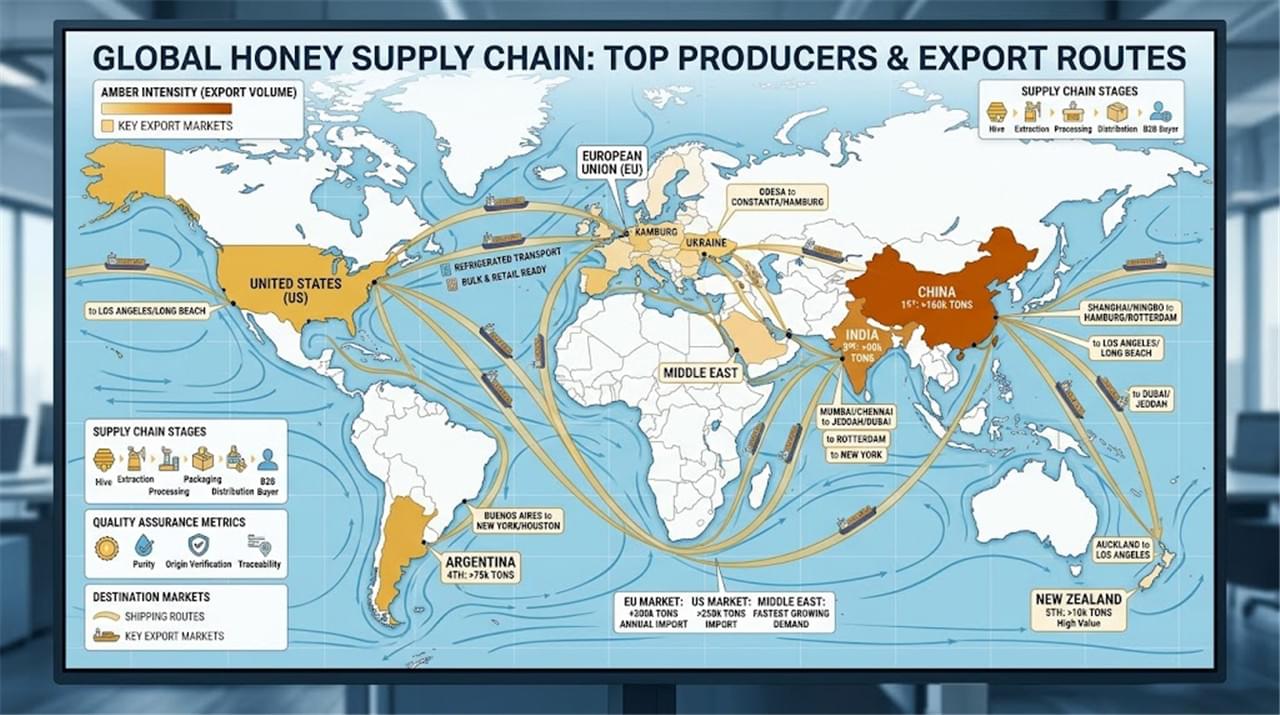
Every sound global honey sourcing program begins with a map, because origin determines varietal, quality ceiling, regulatory burden, and risk profile all at once. Here’s the five-origin snapshot that matters most:
China — ~480,000 MT/year, roughly 26% of global output. Varietals run from linden and rape to jujube, acacia, buckwheat, and wildflower; the primary season stretches March–November, varying north to south. Quality varies widely, from commodity grades to fully traceable export honey. GACC registration is mandatory for EU export, and antibiotic and pesticide history demands comprehensive testing. The honest B2B read: China honey sourcing is the world’s most important supply lane — don’t avoid it on reputation alone; validate it through documentation and independent testing. The GACC China export registration database is where registration claims get verified.
Argentina — ~73,000 MT/year of eucalyptus, clover, sunflower, and pampas wildflower, harvested December–April. EU-compliant quality, mature export infrastructure, direct EU/US access — the natural diversification play against China concentration, with a complementary southern-hemisphere season.
Ukraine — ~68,000 MT/year of sunflower, phacelia, and linden, May–September, with a good EU-compliant track record. Geopolitical risk since 2022 disrupted volumes; rebuild qualification with reliable suppliers before committing volume.
India — ~65,000 MT/year and the largest exporter to the US by volume. Mustard, eucalyptus, litchi, and sunflower; multiple harvests with February–May primary. Quality is variable and the US market has seen adulteration issues, so FDA registration plus full pesticide and antibiotic panels are essential — the US FDA honey import requirements set the baseline.
New Zealand — ~20,000 MT/year, November–March, home of the world’s highest-value honey. Manuka volume is limited and expensive; verified UMF/MGO certification is essential and counterfeit Manuka is a genuine problem — work only with MPI-verified exporters.
🗓️ The Seasonal Calendar Behind Global Honey Sourcing
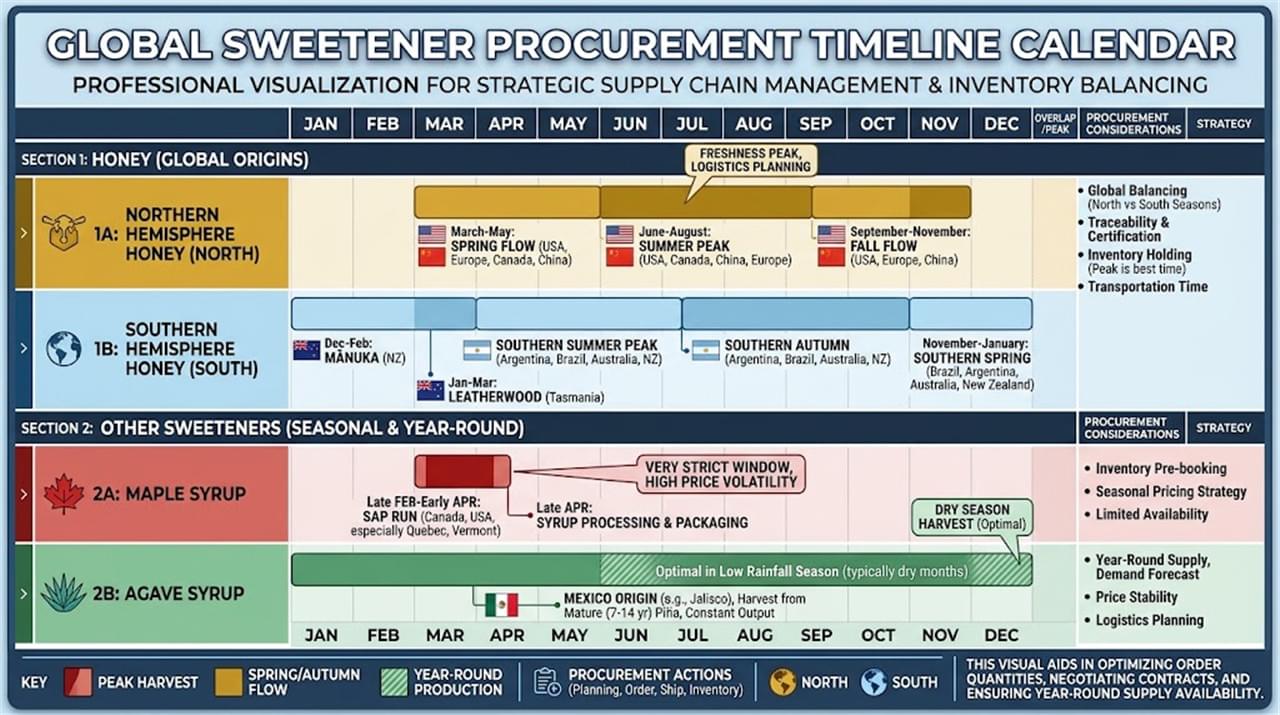
Seasonal honey procurement is where plans are won: production windows decide when to book, and booking late means competing for someone else’s allocation.
| Product | Primary Production Season | Best Forward Contract Window | Notes |
|---|---|---|---|
| Northern hemisphere honey | May–September | January–March | Book before season starts |
| Southern hemisphere honey | November–March | August–October | Complementary season |
| Maple syrup | Late Feb–April | Previous October–January | Season-critical timing |
| Agave nectar | Year-round processing | 3–6 months forward | Stable; climate risk managed |
| Coconut sugar | Year-round (tropical) | 2–3 months typical | Seasonal weather risk |
| Brown rice syrup | Year-round processing | 1–2 months typical | Most flexible timing |
The pattern worth internalizing: contract northern-hemisphere honey before May, lean on southern-hemisphere origins for the counter-season, and treat maple as the least flexible calendar in the category. FAO honey trade data underpins the origin-level volumes.
🛃 Import Regulations: Where Global Honey Sourcing Meets Law
Two destination markets set the template for global honey sourcing compliance. Into the EU, the sequence runs: GACC facility registration (China-origin only) → export health certificate from the origin authority → EU entry declaration via customs broker → product compliance (pesticide test report, CoA) → accurate origin labeling on everything. Rotterdam, Hamburg, Antwerp, and Le Havre all have established honey import infrastructure and inspection facilities.
Into the US, the steps are: FDA facility registration of the foreign supplier → prior notice to FDA before arrival → FSVP compliance carried by the US importer → accurate commercial invoicing → CBP entry filing. One expensive surprise to avoid: several countries face anti-dumping and countervailing duties on honey — verify current duty status for your origin before finalizing any bulk honey import, not after.
🔍 Honey Supplier Evaluation: The 3-Tier Filter
Honey supplier evaluation is the discipline at the heart of global honey sourcing — the one that separates a dependable source from an expensive lesson. Three tiers, in order:
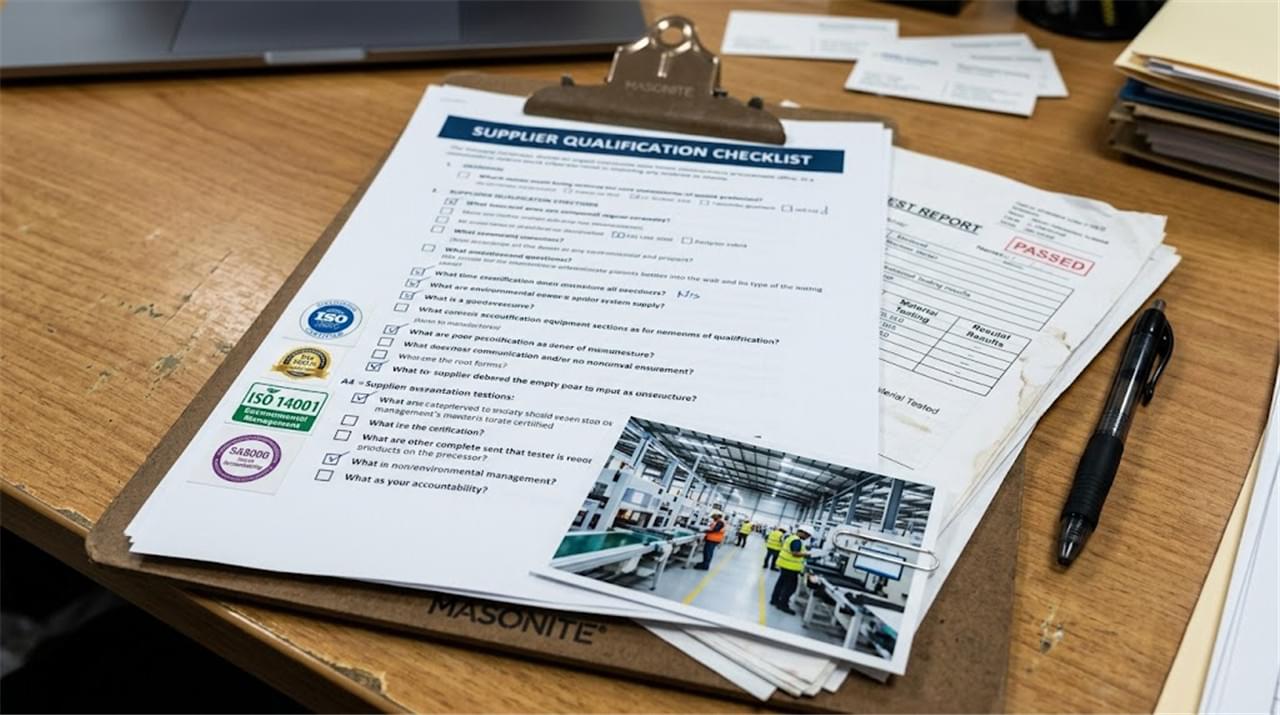
Tier 1 — Documentation. Before any commercial order, verify: business and export licenses (valid, current, scope covers your product), GACC registration number matching the actual facility, ISO 22000/FSSC certificates checked against the issuing body’s database, HALAL/organic certificates covering your specific product, third-party test reports from the last 6–12 months covering all required parameters, and CoAs from the last three lots for consistency.
Tier 2 — Facility qualification. For ongoing supply: an on-site or third-party audit of environment, hygiene, equipment, and documentation systems; a quality team that can actually explain its HACCP system and CCP monitoring; a traceability demonstration tracing a specific lot back to source apiaries; and a corrective-action record for the past two years.
Tier 3 — Trial order protocol. Before full volume: order a small trial lot (1–2 drums), commission independent full-panel testing, verify against specification and sample, evaluate documentation completeness, and assess communication responsiveness. For the full framework, see our Supplier Evaluation Guide and the Quality Standards and Certifications guide.
📦 Logistics and Packaging: The Last Mile of Global Honey Sourcing
Even a perfect supplier fails on bad logistics. Standard bulk packaging runs in four formats: food-grade steel drums (300 kg, the standard), HDPE drums (300 kg, lighter), IBCs (1,000 L / ~1,400 kg, high volume with less handling), and 25 kg pails for secondary bulk and foodservice. Honey stores well — 2–5 years under cool, dry, dark, sealed conditions — but temperature fluctuations accelerate HMF accumulation, so write storage conditions into the supply agreement.
| Mode | Typical Transit Time | Cost Relative | Suitability |
|---|---|---|---|
| Sea freight (FCL) | 15–35 days (origin dependent) | Low | Standard bulk orders |
| Sea freight (LCL) | 25–45 days | Medium | Smaller trial orders |
| Air freight | 2–7 days | High | Urgent; premium; small volume |
| Land transport (intra-EU/US) | 1–7 days | Medium | Domestic distribution |
For varietal-level product knowledge behind all this sourcing logic, the Honey Varieties and Production Guide and our honey adulteration testing standards coverage are the natural next reads — and market context lives in the Global Market Trends overview.
 English
 Arabic
 French
 German
 Portuguese
 Russian
 Spanish
 Japanese
 Korean