
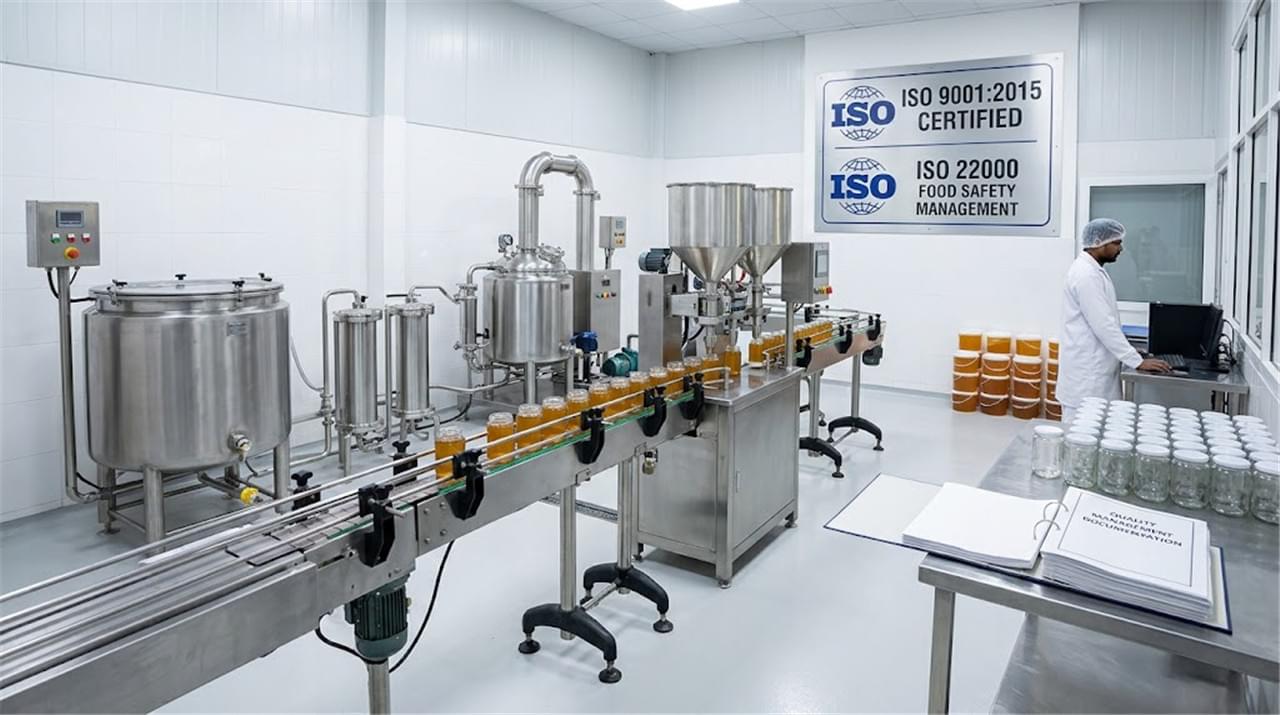
A certificate on the wall tells you a supplier passed an audit. Understanding what that audit actually verified — and what paperwork it generates — tells you whether the system is genuinely robust or paper-compliant. For procurement teams qualifying sweetener suppliers, that difference decides everything. This guide walks through how quality management sweetener production really works: the ISO 22000 framework, the HACCP engine inside it, the GMP floor beneath it, and the documents you should demand before signing anything.
⭐ No certification is bulletproof. But the three layers below, taken together, are the closest thing a buyer gets to certainty. ISO 22000 manages the system, HACCP manages the hazards, GMP manages the hygiene floor. Audit all three and the paper-compliant suppliers start to disappear.
ISO 22000: The Anchor of Quality Management Sweetener Production
ISO 22000 is the food safety management system standard published by the International Organization for Standardization, and it anchors most certified supplier programs. It folds HACCP principles into a broader management framework borrowed from ISO 9001, so a single audit covers hazard control plus the management systems around it. The ISO 22000 standard overview is worth a skim if you want the requirements straight from the source — but the buyer’s edition lives below.
Core Requirements of a Quality Management Sweetener Production System
Four elements carry most of the weight. Management commitment means senior people show up: documented policy, objectives, and regular management reviews, not a delegated signature. Interactive communication requires documented exchanges with raw material suppliers upstream and customers or retailers downstream, so hazard information actually travels both ways. Prerequisite programs (PRPs) set the hygiene floor — for honey and sweetener production that means facility zoning, pest exclusion, drains, equipment sanitation, water quality, allergen management, and staff hygiene training. Verification and validation close the loop: the system is confirmed as implemented, then confirmed to actually control the hazards it identified.
What ISO 22000 Certification Tells B2B Buyers
A certificate is evidence, not proof. Here’s the honest split:
| What it confirms | What it doesn’t confirm |
|---|---|
| Third-party verified management system | Product quality of any specific lot |
| Annual surveillance audits conducted | Testing results of specific shipments |
| Documented hazard identification and controls | Raw material quality from supply chain |
| Corrective action processes in place | Absence of adulteration |
Verification action: before you file that certificate, check its validity against the issuing body’s online database. An expired certificate — or one under suspension — quietly invalidates a supplier’s claimed status. It’s a five-minute check that disqualifies more vendors than any lab test will.
HACCP: Where Quality Management Sweetener Production Gets Tested
HACCP — hazard analysis and critical control points — is the systematic engine that finds, evaluates, and controls food safety hazards. In quality management sweetener production, a defensible plan documents three hazard categories and the controls attached to each. The Codex HACCP guidelines remain the international reference for building one.
Biological Hazards
| Hazard | Risk Scenario | CCP/Control |
|---|---|---|
| Clostridium botulinum | Raw honey; survives honey’s osmotic environment (non-germinating but not killed) | No CCP needed in production; label control for infant use |
| Yeast fermentation | Elevated moisture honey; improper storage | Moisture testing CCP; water activity control in storage |
| Patulin (mycotoxin) | Rare; from flower sources | Not typically a CCP; raw material sourcing control |
Chemical Hazards
| Hazard | Risk Scenario | CCP/Control |
|---|---|---|
| Pesticide residues | Apiary placement near agricultural land; migratory exposure | Supplier apiary protocols; annual pesticide testing |
| Veterinary drug residues | Irresponsible disease treatment | Beekeeper documentation; antibiotic testing |
| Heavy metals | Contaminated processing equipment; industrial proximity | Equipment specification; periodic testing |
| HMF formation | Excessive heat during processing | Temperature-time monitoring CCP |
Physical Hazards
Wax particles, bee parts, dust — mostly handled through filtration CCPs, with screen mesh size specified and verified. Unromantic, but physical hazards are the ones that show up in consumer complaints, so the controls deserve real attention.
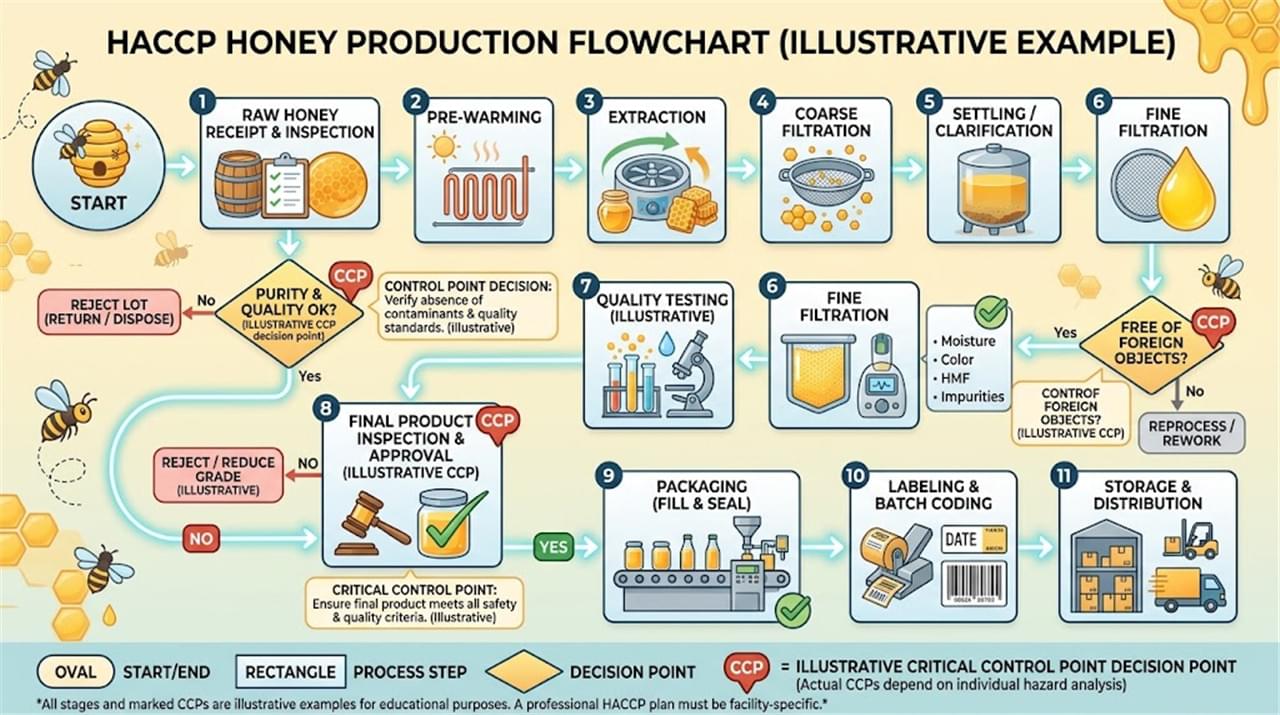
Typical CCPs in a Honey Processing Facility
Most honey facilities converge on five critical control points — the same five you’ll find in almost any quality management sweetener production audit:
- Extraction moisture monitoring — target ≤18%; reject or reprocess if exceeded
- Heating temperature control — temperature and time limits that keep HMF in check
- Filtration integrity — screen mesh verification plus visual inspection
- Metal detection — final product check before packaging
- Packaging integrity — container seal verification
A mature honey HACCP system documents all five and, just as importantly, proves each was monitored when it should have been. Records are the difference between a plan and a plan on paper.
GMP: The Floor Beneath Quality Management Sweetener Production
GMP — good manufacturing practices — sets the operational baseline for quality management sweetener production. Where HACCP manages specific hazards, GMP makes sure the facility, equipment, and people don’t create new ones. Look for four pillars in any GMP sweetener production program:
Facility requirements:
- Smooth, cleanable surfaces in production areas
- Positive air pressure in packing areas
- Separate raw material and finished product storage
- Pest exclusion systems
Equipment requirements:
- Food-grade contact surfaces (stainless steel 304/316 typically)
- Documented cleaning and sanitization schedules
- Equipment calibration records
Personnel requirements:
- Hygiene training documentation
- Health screening for foodhandlers
- Protective clothing requirements by zone
Documentation requirements:
- Cleaning records
- Equipment calibration logs
- Pest control records
- Visitor access logs
Look closely at that last bucket — in quality management sweetener production, cleaning logs, calibration records, and pest control visits are the paper trail that makes everything else credible. A supplier who can’t produce last month’s cleaning records probably can’t produce last month’s safety either.
Auditing Quality Management Sweetener Production: 7 Documents to Request
When you’re auditing quality management sweetener production, move from screening to qualification with a specific set of records. Any serious supplier already has these ready:
Documentation to request:
- Current ISO 22000 or FSSC 22000 certificate — verify the scope covers honey or sweetener production, not just “food”
- HACCP plan — at minimum, a CCP summary table
- Last internal audit report summary
- Last three months of CCP monitoring records (customer-confidential data redacted)
- Corrective action log for the past 12 months
- Pest control service records
- Equipment calibration records for critical instruments — refractometers, thermometers, scales
For high-volume relationships, go one step further with an on-site audit. Watch for incoming raw material inspection records, production batch records and lot coding, finished product hold-and-release procedures, and recall system test results. That’s where an ISO 22000 honey supplier’s claims either hold up or quietly fall apart.
Delimfg operates under full ISO 22000 certification with HACCP documentation available for buyer qualification — the same package we’d hand any serious procurement team. At the end of the day, quality management sweetener production is about records, not rhetoric. To see how the standards fit together, start with our Quality Standards and Certifications Guide, then dig into Honey Quality and Adulteration Testing, the Global Standards Codex EU USDA comparison for market-specific rules, and Certifications: Organic, HALAL, and Kosher for the commercial layer.


 English
 Arabic
 French
 German
 Portuguese
 Russian
 Spanish
 Japanese
 Korean