
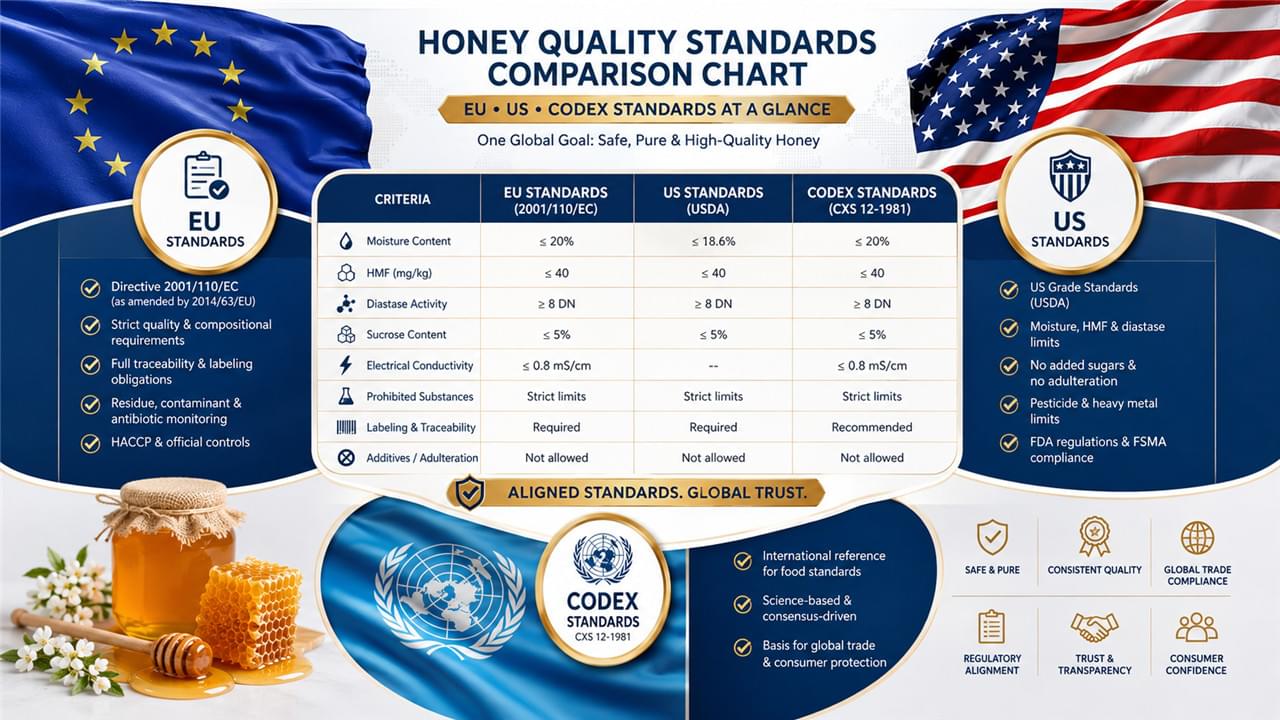
If you’re sourcing honey for multiple export markets, you’re living in three regulatory worlds at once — and they don’t always agree. Codex gives you an international baseline, then the EU and US add their own twists on top. The good news: honey import standards overlap far more than they conflict. This guide shows you where the three frameworks line up, where they diverge, and how to build one compliance approach that satisfies all of them.
⭐ Why Honey Import Standards Vary by Market
Start with the pecking order. Codex Alimentarius (FAO/WHO) produces voluntary international standards that most national regulations use as a baseline under WTO agreements — countries can go stricter, but they have to justify why. The current honey text is the Codex honey standard CODEX STAN 12-1981.
The EU implements Codex minimums and then adds requirements of its own, mostly through the Honey Directive (2001/110/EC, amended 2014) and the Food Contaminants Regulation (EC 1881/2006). The US is the outlier: USDA honey standards are limited to voluntary grading, and there’s no comprehensive federal standard of identity — FDA regulates honey as a food product.
The practical takeaway: when honey import standards differ, the EU is usually the one setting the higher bar, and the US is usually the one with the looser rulebook.
🧪 Chemical Parameters Comparison
The chemistry is where the three frameworks look most alike:
| Parameter | Codex | EU (Council Directive) | USDA Grade A |
|---|---|---|---|
| Moisture | ≤20% | ≤20% | ≤18.6% |
| Fructose + glucose (blossom) | ≥60% | ≥60% | Not specified |
| Sucrose content | ≤5% | ≤5% (standard); higher for some types | Not specified |
| HMF | ≤40 mg/kg | ≤40 mg/kg (≤80 for tropical origin) | Not specified |
| Free acidity | ≤50 mEq/kg | ≤50 mEq/kg | Not specified |
| Diastase activity | ≥8 Schade | ≥8 Schade | Not specified |
| Apparent reducing sugars | ≥65% | ≥65% | Not specified |
🔬 Honey Import Standards: Moisture, HMF, and Purity
Two details are worth pausing on. First, the Codex honey moisture HMF limits are effectively identical to the EU’s — the same numbers, the same logic, one set of documents. Second, USDA Grade A is the surprising one: it sets a stricter moisture ceiling (≤18.6%) than Codex or the EU, yet specifies no chemical purity parameters at all. If your buyer demands “USDA Grade A,” you’re getting a grade, not a purity guarantee.
🏷️ Labeling: Where Honey Import Standards Turn Strict
Labeling is the sharpest divergence — and it’s an EU story:
| Requirement | Codex | EU | US |
|---|---|---|---|
| Country of origin | Recommended | Mandatory | Required on imported goods |
| Blend labeling | — | List all countries OR “EU/non-EU blend” | “Product of X, Y” |
| Filtered honey label | — | Must state “filtered honey” | No specific requirement |
| Baker’s honey label | — | Must identify as “baker’s honey” | Not defined |
The EU honey directive requirements are among the strictest labeling rules in the world: a blend of Chinese and European honey must name both countries, or use the formula “blend of EU and non-EU honey.” The EU also defines product types more precisely — filtered honey and baker’s honey each carry mandatory labels, while comb honey gets a lighter touch. Reselling into EU markets means your origin documentation must be accurate down to the lot, because that’s exactly what the label will say.
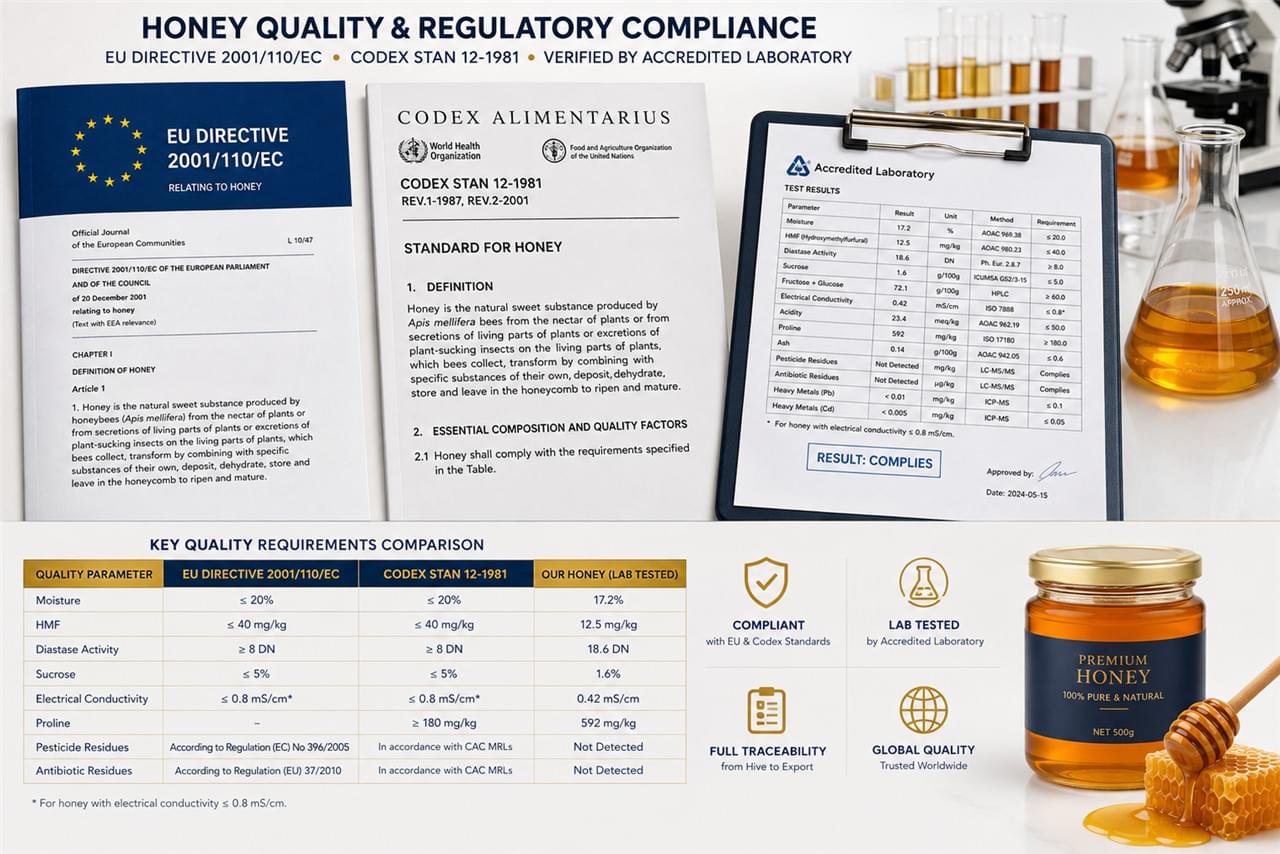
🧫 Contaminant Limits: The Toughest Honey Import Standards
EU Pesticide MRLs
The EU runs the most comprehensive pesticide framework in food, and honey is fully inside it:
- Thousands of individual pesticide MRLs apply
- Default MRL for compounds without honey-specific limits: 0.01 mg/kg (effectively the limit of quantification)
- Multi-residue testing is effectively mandatory for EU market access
US Pesticide Requirements
The US takes the opposite path: FDA has no honey-specific pesticide MRLs and instead enforces general food safety standards. In practice, buyers importing for US retail test against EU MRLs anyway — it’s the conservative benchmark, and it keeps one testing program covering both markets.
⚠️ Antibiotic Residues: The Honey Import Standards Red Flag
| Compound | EU Limit | US Limit | Japan |
|---|---|---|---|
| Chloramphenicol | No permitted level (action limit 0.3 µg/kg) | FDA action level 0.3 ppb | Not detected |
| Nitrofuran metabolites | No permitted level | No permitted level | Not detected |
| Oxytetracycline | 100 µg/kg (MRPL) | No specific MRL | Strict |
| Streptomycin | Not permitted | Not permitted | Not detected |
This is the panel that has historically tripped up China-origin honey, chloramphenicol especially. Every import from China needs antibiotic testing before EU and US entry — this isn’t a nicety, it’s a gate. For the full method-level picture, see our Honey Quality and Adulteration Testing page.
🧭 A Practical Honey Import Standards Strategy
If you supply EU and US buyers from the same source, work from four rules:
- Test to EU standards as the default — EU limits are generally stricter, so EU-compliant product is almost always US-compliant
- Maintain origin documentation — EU traceability demands lot-level records through the whole chain
- Check market-specific antibiotic panels — the EU, US, and Japan each want different tests
- Verify HMF at delivery — HMF climbs with time and temperature; a compliant shipment can blow the limit by the time it reaches the end processor
That single approach covers most of what honey import standards ask of you. For the full certification picture, our Quality Standards and Certifications Guide is the parent document; for origin and supply logistics, the Global Honey Sourcing Guide covers the sourcing side; and if your target markets add religious or organic schemes on top, the HALAL Organic Certifications page fills in the gaps. FDA entry requirements are spelled out in the FDA honey import requirements section for reference.

 English
 Arabic
 French
 German
 Portuguese
 Russian
 Spanish
 Japanese
 Korean