
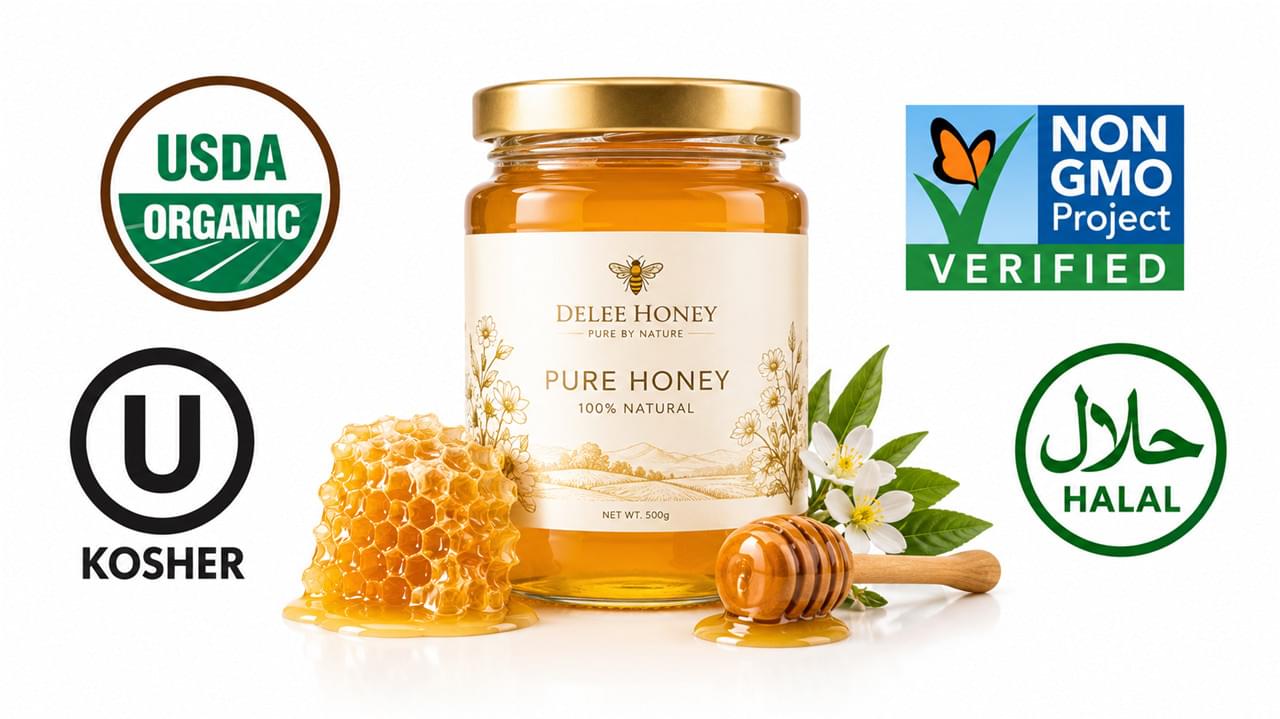
Four labels decide more shelf space in the natural sweetener market than any lab result: organic, non-GMO, Kosher, and HALAL. Each opens a distinct customer segment, each carries its own supplier obligations, and each needs to be verified — not assumed. Here’s the working framework procurement teams use to evaluate natural sweetener certifications before the next purchase order goes out.
⭐ The short version: organic is the heaviest lift of the four natural sweetener certifications, non-GMO is mostly paperwork for honey, Kosher is a US retail gate, and HALAL is a map of target markets. Get the verification order right and you stop paying for labels your customers never asked about.
Organic: The Heaviest Lift Among Natural Sweetener Certifications
Organic is the most demanding of the natural sweetener certifications because it reaches all the way back to the farm — and with bees, the farm flies. The organic honey certification requirements begin at the foraging zone and end at the package line:
Farm-level requirements:
- Foraging zone: all primary nectar sources within 2–3 km certified organic or unmanaged natural vegetation
- Prohibited substances: no synthetic pesticides, herbicides, or fungicides in hive treatment or apiary area
- Varroa management: approved organic treatments only (thymol, oxalic acid, formic acid) — no synthetic miticides
- Supplemental feeding: organic-certified feed during dearth periods
Processing-level requirements:
- Certified organic facility or dedicated organic processing lines
- No cross-contamination with conventional honey
- Organic-certified packaging materials
- Full traceability from farm to package
Standards differ by market, and across natural sweetener certifications this is where the differences bite hardest for exporters:
| Standard | Market | Certifying Bodies | Key Specifics |
|---|---|---|---|
| USDA NOP | United States | QAI, CCOF, OCIA, others | Strict foraging zone; annual inspection |
| EU Organic (EC 848/2018) | European Union | Multiple national bodies | Farm + facility; 3-year transition required |
| JAS Organic | Japan | Multiple accredited bodies | Japan-specific requirements |
| Canada Organic (COR) | Canada | Pro-Cert, ECOCERT Canada | EU-equivalent; mutual recognition |
Cost premium: certified organic honey typically commands 50–200% over conventional at the ingredient level — the widest price spread among natural sweetener certifications, and a reflection of genuine production complexity rather than marketing margin. If the US is your destination, the USDA National Organic Program requirements are the reference text.
For rice syrup, agave, maple, and other plant syrups, the burden is lighter but real: no synthetic pesticides or fertilizers at source, non-GMO source materials, certified organic processing aids, and an annual third-party audit.
Non-GMO: The Quiet Corner of Natural Sweetener Certifications
For honey, non-GMO is mostly documentation. Bees forage from natural vegetation, so GMO risk is inherently low, and Non-GMO Project verification mainly covers supply chain records and testing protocols. For plant-based lines, non-GMO syrup certification is genuinely substantive:
- Rice syrup: rice is a GMO crop in some regions; verification requires testing of the source rice
- Corn-derived products: HFCS and corn syrup must use non-GMO corn varieties to be marketed as non-GMO
- Soy lecithin (if used as a processing aid): needs its own non-GMO verification
EU rules add a threshold: labeling declaration is required only if GMO content exceeds 0.9%. Honey sits comfortably below it; rice and grain syrups may need testing to keep organic claims intact.
Kosher Certification: Small Symbol, Big Market
Among natural sweetener certifications, Kosher is the one US retail buyers ask about first. Under Jewish dietary law, honey is inherently kosher and pareve — neither meat nor dairy. So what does the symbol actually buy you? Certification confirms no non-Kosher processing aids, no equipment shared with non-Kosher products without proper kashering, and supervision by a recognized agency with your product on its approved list.
| Agency | Symbol | Global Recognition | Notes |
|---|---|---|---|
| Orthodox Union (OU) | OU ◉ | Highest global recognition | Most widely accepted |
| Star-K | ★-K | Strong US/international | Reliable |
| KOF-K | KOF-K | Strong US | Large certifier |
| cRc | cRc | US/international | Conservative standards |
Commercial significance: the US kosher market runs roughly $12 billion in annual retail sales, and OU is the de facto standard for major US retail buyers. When checking a supplier’s Kosher file, verify three things: the certificate scope matches your exact product, both facility and product are covered (not just the facility), and the renewal date is current — Kosher certificates renew annually.
HALAL: The Market Gate Among Natural Sweetener Certifications
Honey is inherently halal under Islamic dietary law — certification exists for the processing, not the bees. A compliant setup means no cross-contamination with haram substances at any stage, no alcohol-based sanitizers on honey-contact equipment, chain-of-custody documentation, and an annual third-party audit. A serious HALAL sweetener supplier hands all four over without prompting.
| Certification Body | UAE | Saudi Arabia | Malaysia | Indonesia | EU/US Markets |
|---|---|---|---|---|---|
| JAKIM (Malaysia) | Recognized | Partial | Authority | Recognized | Widely accepted |
| BPJPH (Indonesia) | Recognized | Recognized | Recognized | Authority | Growing |
| ESMA/UAE | Authority | Recognized | Recognized | Recognized | Regional |
| IFANCA (US) | Accepted | Accepted | Accepted | Accepted | US Muslim market |
Critical for market access: HALAL is the most territorial of the natural sweetener certifications — verify which bodies your target market recognizes before accepting a supplier’s certificate. A Malaysian JAKIM certificate may not satisfy Saudi SASO requirements; the matrix above is a starting point, not a substitute for checking current import rules.
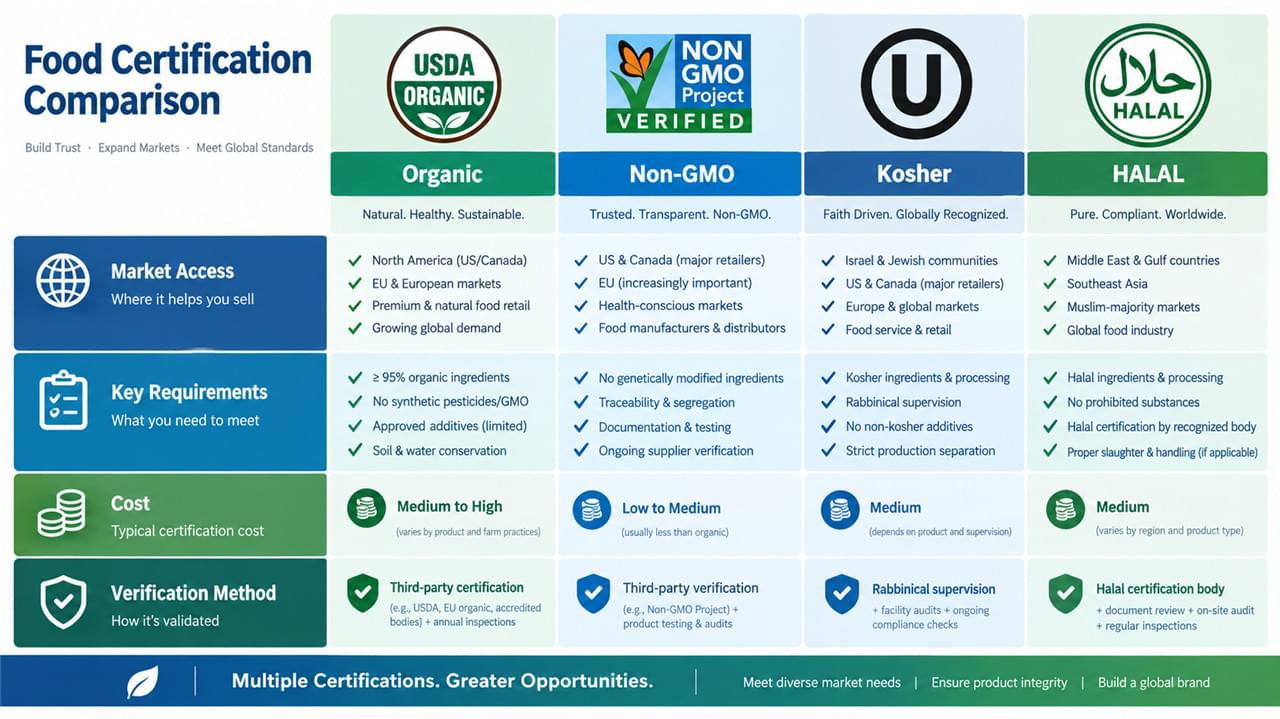
Verifying Natural Sweetener Certifications: A Four-Label Checklist
Whatever the label, run the same four-step pass before you accept any certificate:
- Scope — does the certificate name your exact product, not just the facility?
- Validity — check it against the issuing body’s database; expired or suspended certificates are disqualifying
- Recognition — does your target market accept this certifying body?
- Renewal — annual cycles mean last year’s PDF proves nothing
Of the four natural sweetener certifications, none is optional once your customer list includes organic retailers, US grocery chains, or Gulf and Southeast Asian markets — but each should be bought deliberately, not collected. For the full compliance picture, start with our Quality Standards and Certifications Overview, then drill into the Global Standards Codex EU USDA comparison for legal baselines, Honey Quality and Adulteration Testing for lab-level verification, and Sustainability and Ethical Sourcing if your buyers ask about the story behind the label.
For a copy of Delimfg’s current certification portfolio, contact our quality team.


 English
 Arabic
 French
 German
 Portuguese
 Russian
 Spanish
 Japanese
 Korean