

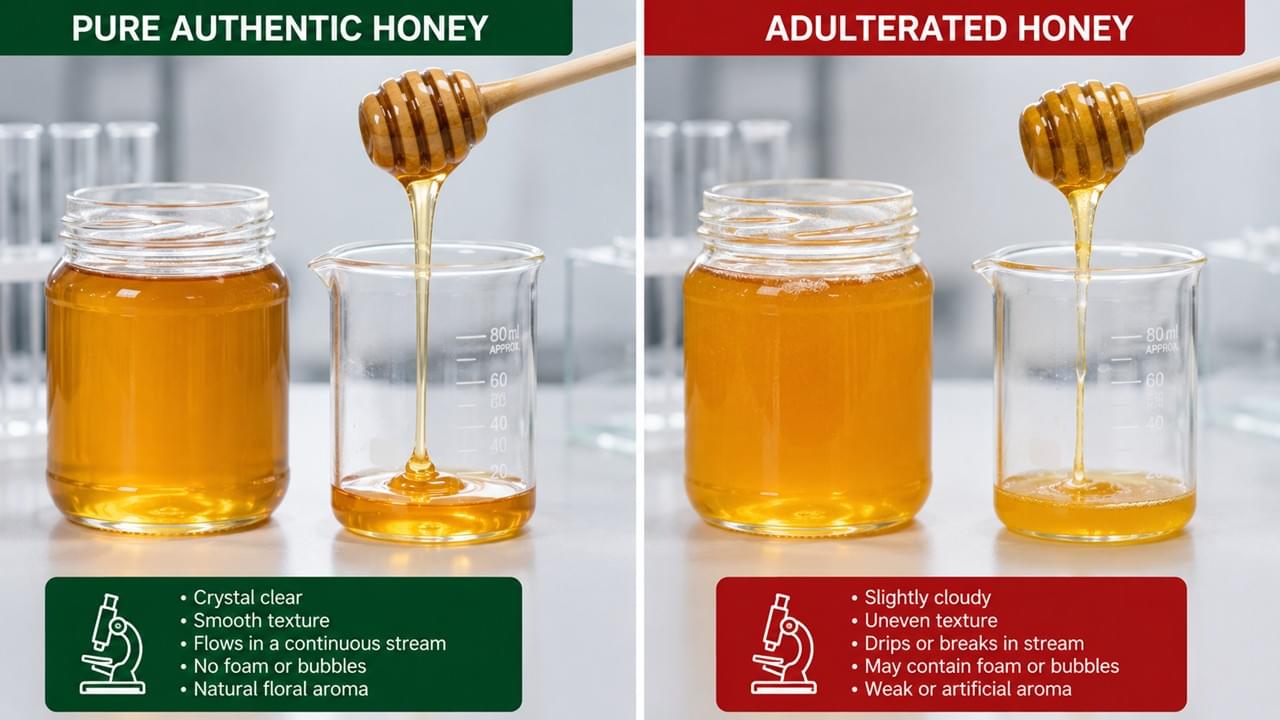
Honey quality testing has become one of the most important safeguards in today’s global honey trade. 🍯 As honey remains among the world’s most frequently adulterated food products, B2B buyers face increasing pressure to verify authenticity, ensure regulatory compliance, and protect brand reputation.
The financial motivation behind adulteration is simple: premium honey commands significantly higher prices than low-cost substitutes like corn syrup, rice syrup, or cane sugar syrup. Without proper testing, importers and distributors risk purchasing diluted or falsely labeled products that may fail regulatory inspections or damage customer trust.
For procurement teams, understanding honey adulteration detection methods, international regulations, and supplier qualification processes is no longer optional — it is essential due diligence.
For additional guidance on sourcing authentic honey products, visit the official Honey Buying Guide.
🍯 Why Honey Adulteration Is a Serious Global Issue
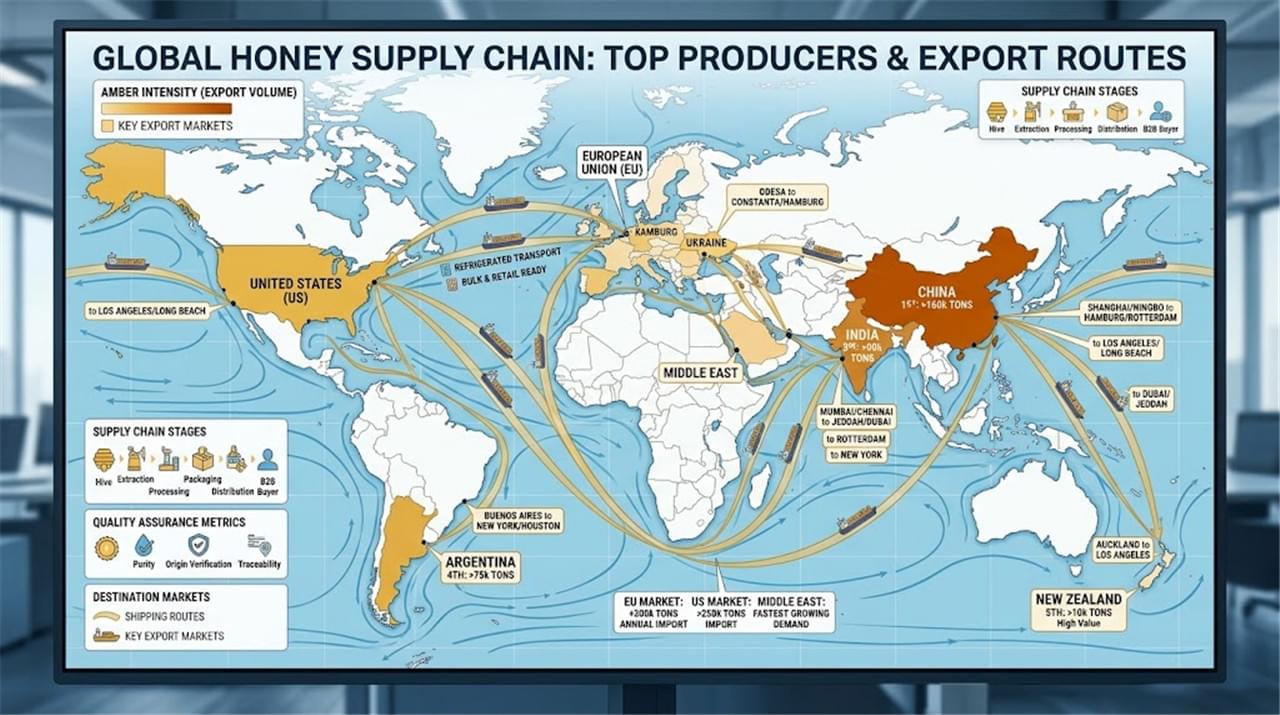
The global honey market has become increasingly complex due to rising demand and fragmented supply chains. In many cases, adulterated honey enters international trade through bulk blending operations or unclear origin labeling.
🍯 Honey Quality Testing for C4 Sugar Adulteration
One of the most common fraud methods involves adding C4 plant sugars such as high fructose corn syrup (HFCS) or cane sugar syrup. Because genuine honey mainly originates from C3 plants, laboratories can detect these additives through carbon isotope analysis.
The most widely used technique is IRMS (Isotope Ratio Mass Spectrometry), which can identify C4 sugar adulteration at relatively low levels.
Buyers importing bulk honey into regulated markets should request IRMS reports as part of their honey quality testing protocol.
🔬 Honey Quality Testing for C3 Syrup Detection
C3 adulterants are more difficult to detect because they share a similar botanical pathway with natural honey. Common C3 syrups include:
- Rice syrup
- Beet syrup
- Inulin syrup
Traditional isotope testing cannot reliably identify these substances. Instead, advanced technologies such as NMR metabolomics and enzyme-specific analysis are required.
As honey adulteration detection methods continue evolving, many European buyers now require periodic NMR screening for high-volume contracts.
Learn more about modern food authentication technologies from Eurofins Food Testing Services.
🌍 Geographic Mislabeling and Origin Fraud
Another growing concern involves false origin claims. Lower-cost bulk honey may be relabeled as premium regional varieties such as New Zealand Manuka honey or European-origin honey.
To verify authenticity, laboratories may conduct:
- Pollen analysis (melissopalynology)
- Trace element profiling
- Geographic isotope mapping
These methods help confirm floral and regional origin while supporting international honey quality standards compliance.
📋 International Honey Quality Standards Every Buyer Should Know
Understanding international regulations helps buyers reduce compliance risks during import and distribution.
📌 Codex Alimentarius Honey Standards
The Codex Alimentarius Standard for Honey (CODEX STAN 12-1981) establishes globally recognized quality benchmarks.
| Parameter | Requirement |
| Moisture Content | ≤20% |
| Fructose + Glucose | ≥60% |
| Sucrose | ≤5% |
| HMF | ≤40 mg/kg |
| Free Acidity | ≤50 mEq/kg |
| Diastase Activity | ≥8 Schade |
These benchmarks are widely referenced in global honey quality testing procedures.
For official Codex standards, visit Codex Alimentarius Commission.
🇪🇺 EU Honey Directive Requirements
The European Union applies stricter traceability and labeling requirements than many other markets.
Key requirements include:
- Full country-of-origin disclosure
- Label transparency for blended honey
- Restrictions on excessive filtration
- Separate definitions for filtered honey and baker’s honey
European buyers often demand stronger bulk honey supplier qualification documentation before approving imports.
🇺🇸 US Honey Import Standards
In the United States, honey falls under general FDA food safety regulations.
Importers should verify:
- FDA facility registration
- Prior notice compliance
- State-level labeling requirements
- USDA voluntary grading standards
California and New York may apply additional labeling rules compared with federal requirements.
You can review current import guidance at U.S. FDA Food Guidance.
🔬 Essential Honey Quality Testing Methods for B2B Buyers
🧪 Tier 1: Basic Honey Quality Testing
Every shipment should include a Certificate of Analysis (CoA) covering core parameters.
| Test | Purpose | Common Method |
| Moisture | Fermentation risk | Refractometer |
| HMF | Heat damage indicator | HPLC |
| Diastase | Freshness evaluation | Phadebas |
| Free Acidity | Quality verification | Titration |
| Sugar Profile | Adulteration screening | HPLC |
These basic indicators provide the foundation for reliable honey quality testing.
🔍 Tier 2: Advanced Adulteration Screening
For supplier qualification and long-term procurement partnerships, advanced screening is highly recommended.
| Test | Detects |
| IRMS | Cane syrup & corn syrup |
| NMR Metabolomics | Rice syrup & beet syrup |
| Pollen Analysis | Floral origin fraud |
| ICP-MS | Geographic trace elements |
Advanced honey adulteration detection methods significantly reduce sourcing risk for importers.
⚠️ Tier 3: Contaminant and Residue Testing
Regulated export markets often require contaminant analysis before customs clearance.
Important screening categories include:
- Pesticide residues
- Antibiotic residues
- Heavy metals
- Veterinary drug contamination
Japan, the EU, and the United States maintain strict Maximum Residue Limits (MRLs) for imported honey.
For pesticide compliance information, refer to European Food Safety Authority (EFSA).
📑 How to Review Supplier Test Reports Correctly
Many buyers focus only on whether a supplier provides a test report. However, the credibility of the documentation is equally important.
✅ Verify Laboratory Accreditation
Always confirm the laboratory is ISO 17025 accredited for the specific testing methods listed.
📦 Confirm Lot Traceability
The reported sample should match the exact production batch being offered. Generic annual reports are not sufficient for serious procurement operations.
📅 Compare Production and Test Dates
HMF and enzyme activity can change over time depending on storage conditions. Recent testing provides a more accurate picture of current product quality.
🔄 Request Ongoing Testing
Strong supplier agreements should require:
- Per-shipment testing
- Quarterly verification
- Random third-party audits
This approach strengthens long-term bulk honey supplier qualification programs.
🏭 Certifications That Help Reduce Procurement Risk
While certifications cannot fully replace laboratory testing, they provide additional operational confidence.
📜 Important Certifications for Honey Suppliers
- ISO 22000
- HACCP
- Organic Certification
- HALAL Certification
These systems improve food safety management, traceability, and export readiness.
For more details, you may also explore our internal guide on Honey Quality Standards and Certifications.
🤝 Building a Reliable Honey Supplier Qualification Protocol
A structured qualification process helps buyers minimize commercial and compliance risks.
📌 Recommended Qualification Steps
- Request full certification documentation
- Review recent CoAs from multiple production lots
- Require Tier 1 and Tier 2 laboratory reports
- Conduct independent third-party verification
- Perform factory audits for strategic suppliers
- Define ongoing testing obligations in contracts
At Deli Foods, complete supplier qualification documentation packages are available upon request, including lot-level testing reports, certifications, and facility audit records.
👉 You can also request additional sourcing information through the official Deli Foods Contact Page.
In today’s competitive global honey trade, honey quality testing is no longer just a technical requirement — it is a critical business protection strategy.
From detecting sophisticated syrup adulteration to validating origin claims and contaminant compliance, modern testing protocols help buyers reduce financial losses and safeguard customer trust.
Companies that invest in stronger verification systems, transparent supplier relationships, and internationally recognized testing standards will be better positioned to succeed in increasingly regulated global markets.


 English
 Arabic
 French
 German
 Portuguese
 Russian
 Spanish
 Japanese
 Korean