
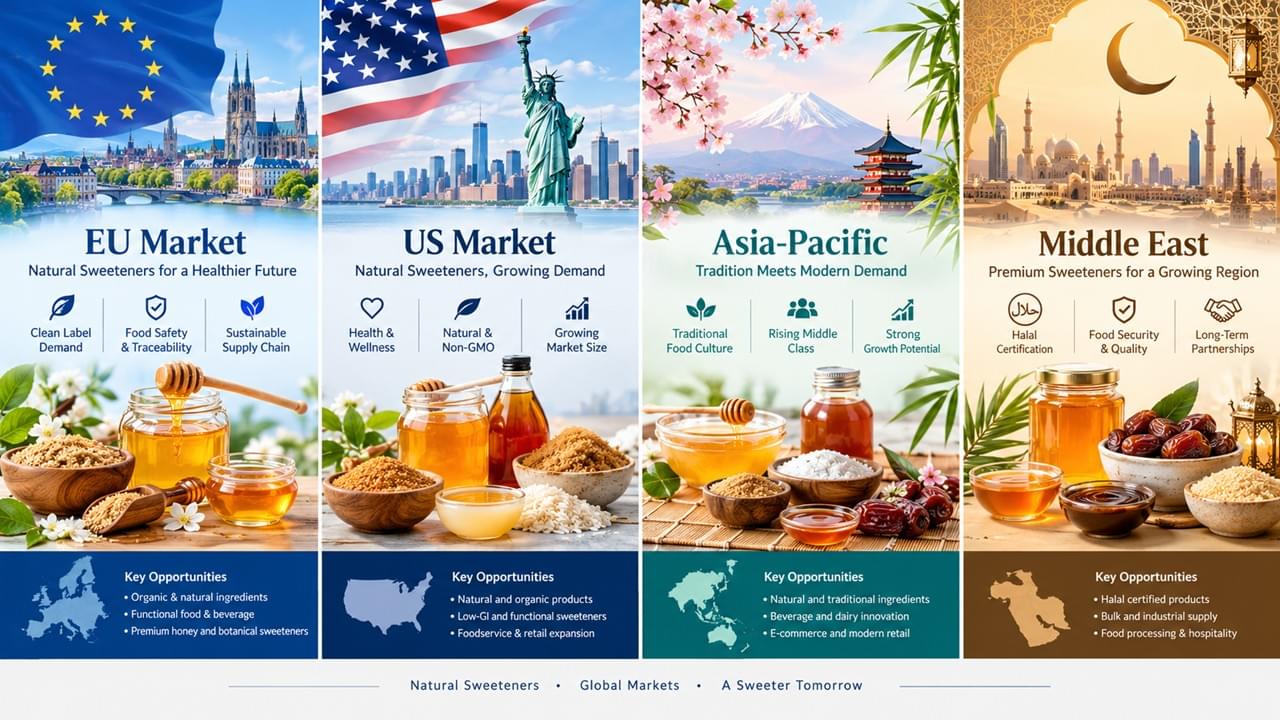
Natural sweetener markets don’t behave uniformly — and treating them as one market is the fastest way to lose money in four places at once. Consumer preferences, regulatory frameworks, and growth dynamics diverge sharply between the EU, the US, Asia-Pacific, and the Middle East. For B2B buyers and suppliers building multi-market strategies, this regional differentiation isn’t a nuance; it’s the strategy. Here’s the map, region by region.
Table of Contents
Toggle⭐ Four Natural Sweetener Markets, Four Rulebooks
The short version across the four natural sweetener markets: Europe buys on regulation and origin, America buys on label and story, Asia buys on quality and culture, and the Gulf buys on certification and occasion. Same ingredients, completely different purchase logic. Get the rulebook wrong and your product stalls at the border or on the shelf. For the global supply picture behind all four, start with our Global Market Trends overview.
🇪🇺 EU: The Most Demanding of the Natural Sweetener Markets
The EU is both the most demanding and the most valuable import market — around EUR 3.2 billion across honey and natural syrups. Regulations are the strictest globally on pesticides, additives, and labeling; consumers pair high health consciousness with a strong preference for organic and origin-labeled products; and roughly 35% of honey sales flow through natural, organic, or premium channels.
The practical gate is documentation. EU honey import requirements look like this:
| Requirement | Honey | Organic Honey | Plant Syrups |
|---|---|---|---|
| Health certificate | Yes | Yes | No (general food safety) |
| GACC registration (China) | Yes | Yes | N/A |
| Pesticide compliance | EU MRL | EU MRL (stricter for organic) | EU MRL |
| Origin labeling | Mandatory | Mandatory | Good practice |
| HACCP/ISO 22000 | Required by most buyers | Required | Required by most buyers |
Within the region, Germany is the largest honey consumer with growing date syrup and coconut sugar retail; the UK runs a separate post-Brexit framework that largely maintains EU MRL equivalence; and the Nordic countries combine very high per-capita organic consumption with zero tolerance for thin premium claims. Eurostat EU import statistics are the reference for tracking flows.
🇺🇸 US: Where Natural Sweetener Markets Follow the Label
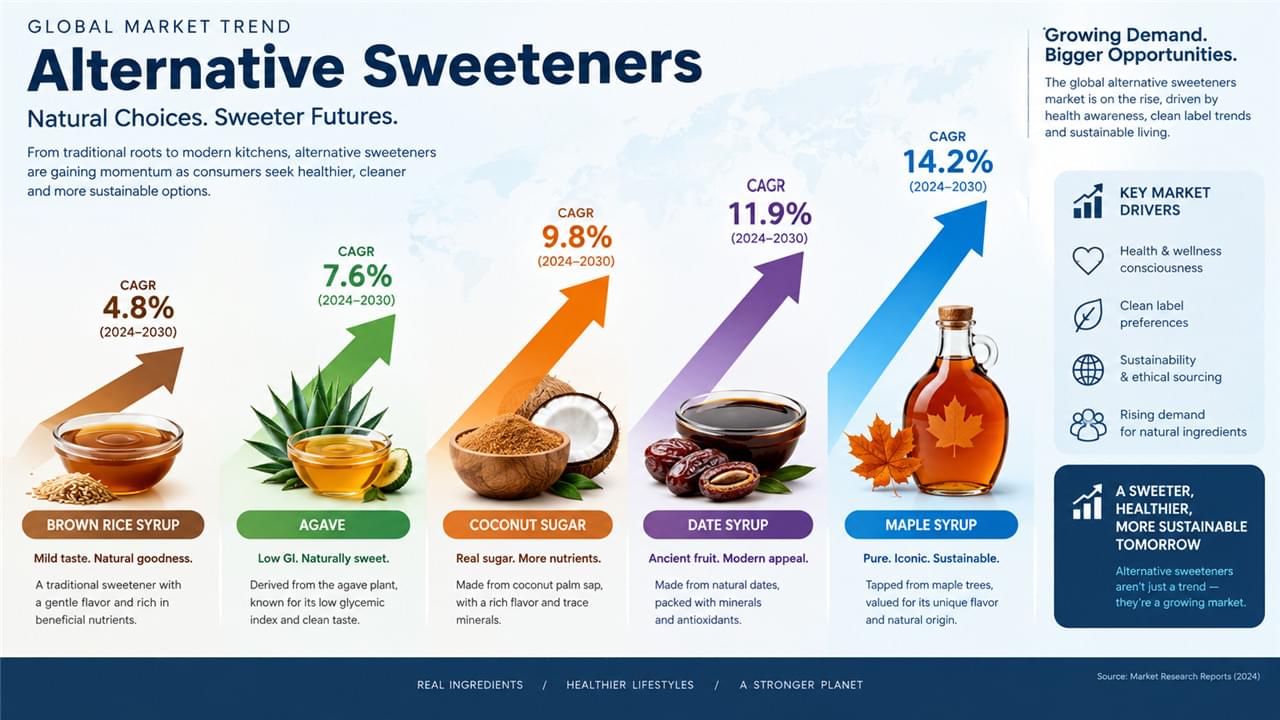
US natural sweetener trends run on a different engine — not regulation, but the clean-label movement. With roughly USD 2.2B in honey and USD 1.8B in alternative sweeteners, the market rewards “real ingredients” language aimed squarely at millennial and Gen Z buyers, while FDA oversight (registration, FSVP importer compliance) stays less prescriptive than the EU’s chemical standards.
Three dynamics matter for B2B sellers. Natural food retail — Whole Foods, Sprouts, Fresh Market, Natural Grocers — delivers the strongest per-unit margins, but demands documentation and often organic or non-GMO certification before a product gets shelf space. Foodservice is quietly scaling: restaurant and QSR chains are adding “local honey” and “made with real maple syrup” to menus as premiumization plays, making B2B foodservice a serious volume channel. And e-commerce brands are growing fast enough that their ingredient sourcing needs are becoming a B2B story of their own. The USDA ERS sweetener data is useful for sizing the underlying consumption base.
🌏 Asia-Pacific: Producer, Connoisseur, and Growth Market in One
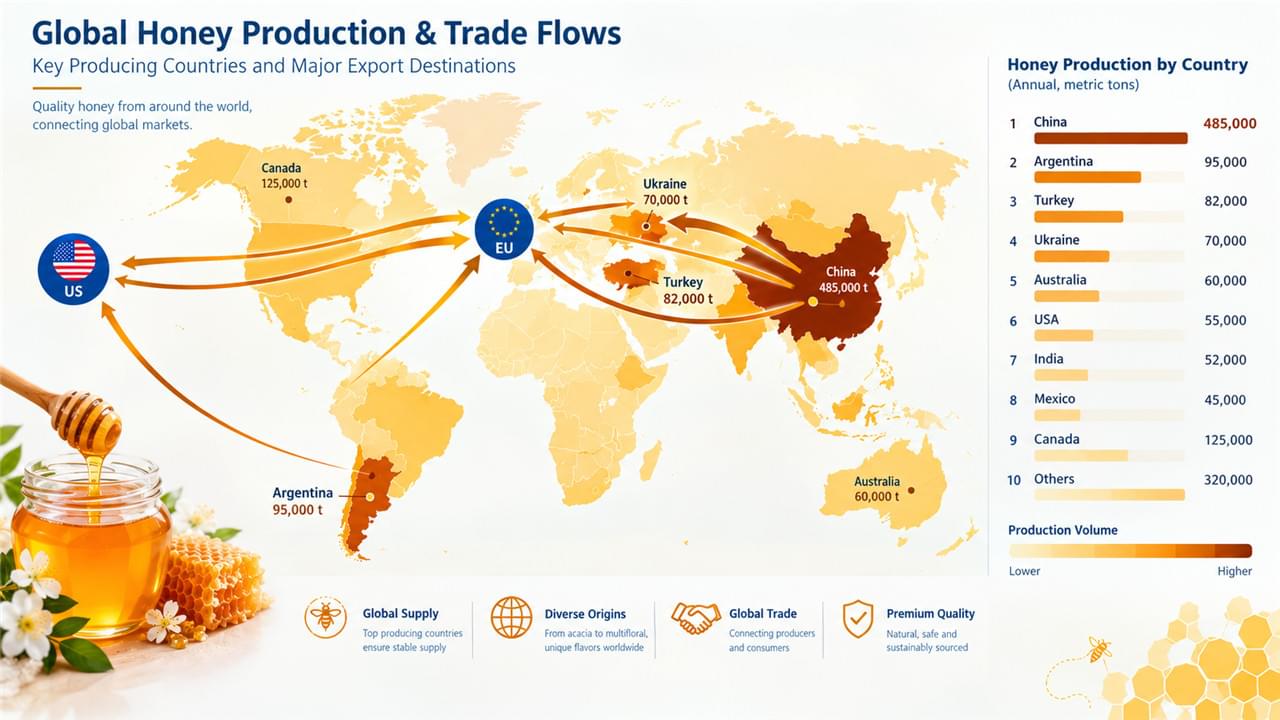
China holds a unique dual position — the world’s largest producer at ~26% of global output and a significant domestic consumer. Domestic honey consumption grows about 5% annually on rising middle-class health awareness, urban buyers are paying up for premium imports like Manuka and European specialty varietals, and strict GACC export controls mean only registered facilities can ship out.
Japan is the region’s connoisseur market: the highest quality import standards in Asia-Pacific, per-capita consumption among the region’s top at roughly 1.2 kg/year, and a strong domestic preference that makes import testing rigorous. Premium Manuka, European acacia, and specialty varietals command real premiums here.
Southeast Asia is the growth flank: HALAL-certified honey is expanding strongly across Muslim-majority Indonesia, Malaysia, and Brunei, rising middle-class incomes are driving premiumization, and coconut sugar — a domestic heritage ingredient — is growing in export significance. For certification detail across these markets, see our HALAL and Organic Certifications guide.
🕌 Middle East: The HALAL Gate and the Premium Crown
Middle East HALAL honey demand rests on a simple rule: certification is non-negotiable for market access. Beyond the gate, the Gulf ranks among the most premium natural sweetener markets in the world — luxury and gift categories like Sidr, Manuka, and premium monofloral command extraordinary prices, and Saudi Arabia’s own Sidr production (Ziziphus species) anchors an extremely high-value traditional category. GCC imports run about 80,000 MT per year, sourced primarily from Turkey, India, and Argentina.
Three openings are worth tracking. The GCC health food segment — UAE, Saudi Arabia, Kuwait — is actively seeking certified natural sweeteners with clean documentation. Ramadan reliably spikes honey and date consumption, so supply and procurement need planning around it, not improvisation. And documented European honeys from Germany, Austria, and Switzerland perform strongly in GCC gift and premium retail, where organic paperwork adds tangible value. Our Global Honey Sourcing Guide covers the origin-by-origin angles.
🧭 What Regional Natural Sweetener Markets Mean for Your Strategy
One product, four plays across the natural sweetener markets: in the EU, lead with compliance and origin; in the US, lead with label and story; in Asia-Pacific, lead with quality credentials and cultural fit; in the Gulf, lead with HALAL certification and gift-worthy premium. Budget for the documentation each market expects — see our Quality Standards and Certifications guide for the full checklist.
 English
 Arabic
 French
 German
 Portuguese
 Russian
 Spanish
 Japanese
 Korean