
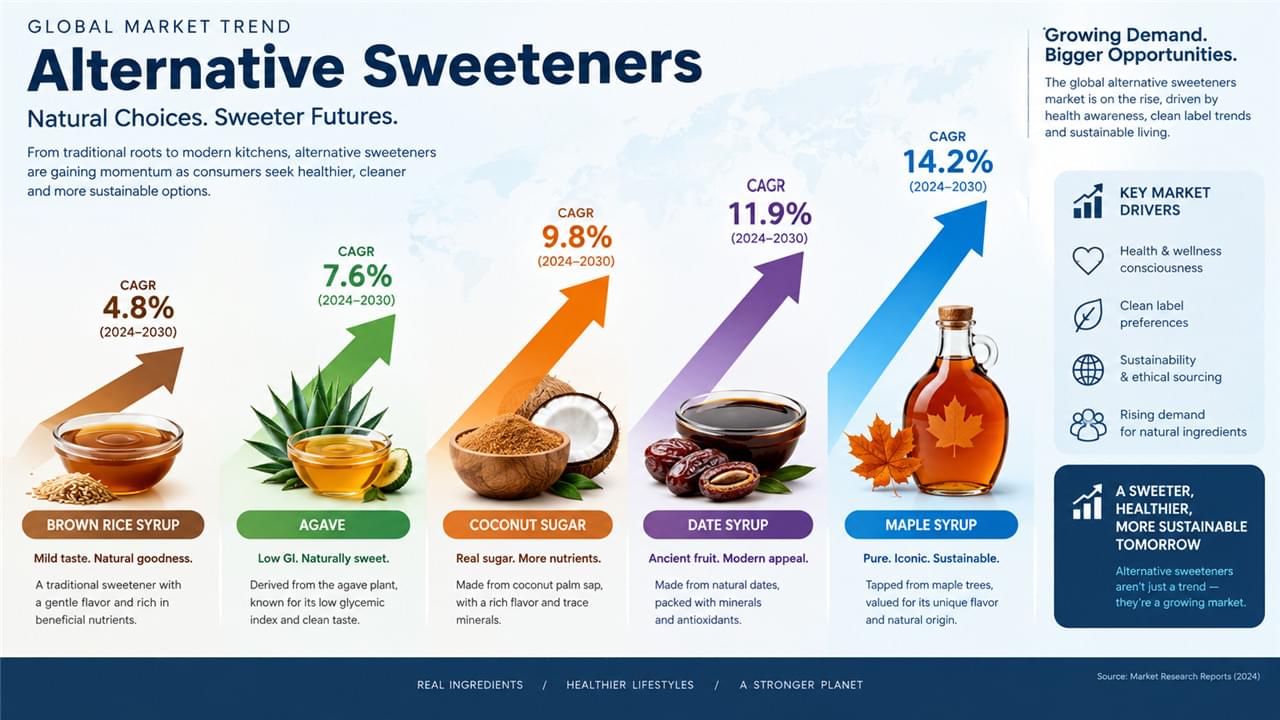
The alternative sweetener market — everything beyond honey and refined sugar — is one of the fastest-growing ingredient categories in food manufacturing, and it’s not growing evenly. Four categories tell four very different stories in 2026: an established workhorse compounding steadily, a one-time star finding its footing again, a premium leader compounding at double digits, and a niche specialty suddenly going mainstream. Knowing which story each ingredient is living helps procurement and commercial teams position their strategies properly.
Table of Contents
Toggle⭐ The Alternative Sweetener Market at a Glance
Here’s the alternative sweetener market in one table — six categories, two distinct growth engines:
| Sweetener | 2024 Global Market | 2030 Projection | CAGR | Key Growth Driver |
|---|---|---|---|---|
| Brown rice syrup | ~USD 650M | ~USD 1.1B | ~9% | Energy bars; clean label; organic |
| Agave nectar | ~USD 380M | ~USD 550M | ~6% | Beverages; better-for-you |
| Coconut sugar | ~USD 580M | ~USD 1.0B | ~10% | Premium clean label; low GI |
| Date syrup | ~USD 120M | ~USD 320M | ~18% | Natural food retail; MENA cuisine |
| Maple syrup | ~USD 1.4B | ~USD 2.0B | ~7% | Premium retail; seasonal |
| Molasses | ~USD 890M | ~USD 1.2B | ~5% | Industrial fermentation; specialty |
For the honey side of the picture, see our Global Market Trends overview. For the full Grand View Research alternative sweeteners market report, the category-level forecasts go deeper.
🌾 Brown Rice Syrup: Anchor of the Alternative Sweetener Market
Brown rice syrup is the primary natural replacement for HFCS in clean-label food manufacturing, and the brown rice syrup market rests on three converging demand streams.
Natural and organic food manufacturing is the biggest one. It’s the standard binding sweetener in natural energy bars — think of the Kind, Clif Bar, and Lärabar competitive set — plus organic granola and clean-label snacks. Volume is large and pricing sensitivity is high, which makes supplier economics the decisive factor here.
Infant and toddler nutrition is smaller but demanding. Brown rice syrup has a history in organic baby food, and one caution matters: FDA guidance on inorganic arsenic limits in rice products for infants means any buyer sourcing rice syrup for infant applications must verify supplier arsenic testing compliance — no exceptions.
Geographically, North America leads on per-capita consumption and organic retail depth, Europe is growing through UK, German, and French organic channels, and Japan sustains steady demand on a strong rice-based food culture.
🌵 Agave Nectar Market Trends: Stabilization After Peak
The agave nectar market trends story is a correction, not a collapse. After extraordinary growth from 2005 to 2015 on the strength of low-GI positioning, demand cooled as consumer awareness of agave’s high fructose content created hesitation in some segments.
Where it stands now: growth has stabilized at a mid-range 5–7% CAGR. Beverage applications — RTD drinks and specialty coffee — are the most resilient. Organic agave is outgrowing conventional, and blue agave certification commands a meaningful premium over generic product. The US remains the largest market, the EU’s organic segment is modest but expanding, and Mexico’s domestic consumption grows alongside exports. For how agave compares functionally against the rest of the category, our Comparative Analysis of Sweeteners lays out the trade-offs.
🥥 Coconut Sugar Demand 2026: The Premium Growth Leader
Coconut sugar demand 2026 makes it the fastest-growing major alternative sweetener by volume, and the drivers are structural rather than trendy: an authentic sustainability narrative (tree-tapping without felling), low-GI positioning at around 35, a clean one-word ingredient label, and strong natural retail placement from Whole Foods to EU health food chains.
The watch-point is supply. Production concentrates in Indonesia and the Philippines, and climate sensitivity — drought, cyclones — creates periodic disruptions. For high-volume buyers, a multi-origin procurement strategy isn’t paranoia; it’s planning. The FAO coconut and palm sugar production data is the reference for tracking origin concentration.
🌴 Date Syrup: The Alternative Sweetener Market’s Fastest Grower
Date syrup is the standout: an 18% CAGR projected through 2030, growing from a low base. What started as a niche MENA specialty is crossing into mainstream natural food retail in the EU and US, propelled by clean-label nutrition density, antioxidant positioning, and a natural HALAL credential that needs no reformulation. Application expansion follows the same arc — energy bars, specialty spreads, beverage syrups, and clean-label baked goods. We cover the sourcing detail in our Global Sourcing Guide and the ingredient deep-dive in the Natural Syrups and Alternative Sweeteners Guide.
🧭 What the Alternative Sweetener Market Means for B2B Buyers
For procurement teams: this category is less commoditized than honey. Pricing is less transparent, supply chains run shorter with fewer global traders, and quality specification carries more weight in differentiated products.
For product developers: the fastest-growing categories — date syrup and coconut sugar — align with what consumers currently reward: provenance, minimal processing, nutritional density. Products built on these ingredients can genuinely command premium positioning.
For commercial teams: the growth data supports expanding natural sweetener procurement, but budget testing and certification as a real proportion of ingredient cost — quality compliance is already embedded in competitive pricing, and pretending otherwise just moves the cost somewhere more expensive.
Contact our team for alternative sweetener spply consultation →


 English
 Arabic
 French
 German
 Portuguese
 Russian
 Spanish
 Japanese
 Korean