
Understanding where honey comes from, how it moves, and what it actually costs is the baseline intelligence for any serious B2B honey buyer — and 2026 rewards buyers who dig deeper than a headline price. The global honey market isn’t one market. It’s a handful of producing countries, two dominant importing blocs, and a pricing structure that ranges from 1.80commoditybarrelsto1.80commoditybarrelsto100 Manuka jars. This overview pulls the numbers together for your 2026 procurement planning.
⭐ The Global Honey Market at a Glance
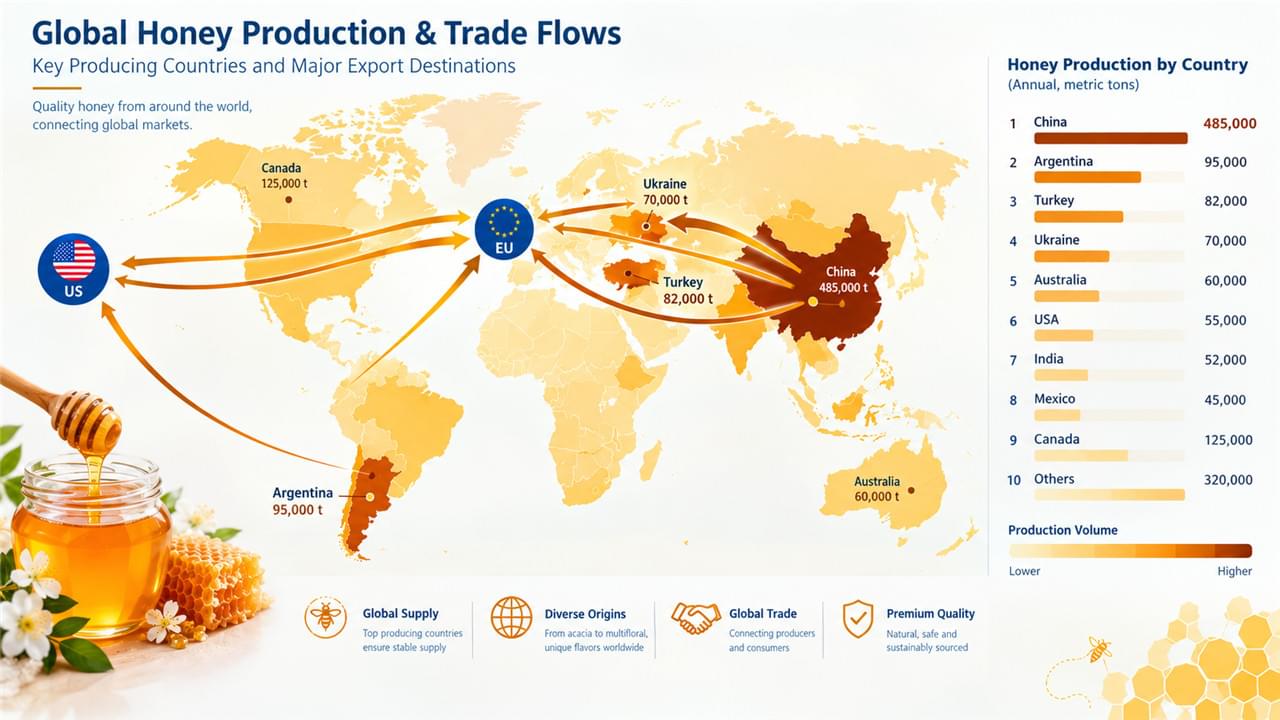
Three numbers frame everything that follows. First: the top 10 producing countries supply roughly 74% of world output, so origin concentration is extreme. Second: the EU alone takes about 45% of global imports by value, which makes European demand the single biggest force shaping export pricing. Third: negotiated prices — not exchange-traded benchmarks — set the deal, which means supplier relationships matter as much as market reports. For the wider context across syrups and sweeteners, see our Global Market Trends overview.
🐝 Honey Production by Country: Who Feeds the Global Honey Market
Production is far more concentrated than most buyers assume. The top 10 honey production by country rankings account for approximately 74% of world output:
| Rank | Country | Estimated Production (MT) | % Global |
|---|---|---|---|
| 1 | China | ~480,000 | ~26% |
| 2 | Turkey | ~115,000 | ~6% |
| 3 | Argentina | ~73,000 | ~4% |
| 4 | Ukraine | ~68,000 | ~4% |
| 5 | India | ~65,000 | ~4% |
| 6 | Iran | ~62,000 | ~3% |
| 7 | Russia | ~55,000 | ~3% |
| 8 | United States | ~55,000 | ~3% |
| 9 | Ethiopia | ~50,000 | ~3% |
| 10 | Mexico | ~47,000 | ~3% |
Here’s the practical takeaway: China’s ~26% share means most commodity-grade bulk honey moving through the global honey market has a China connection somewhere in its history. If you buy, specify, or audit China-origin supply, understanding origin regulations, testing requirements, and GACC export registration isn’t optional background reading — it’s due diligence. The FAO honey production statistics database is the reference source behind these figures.
🚢 Global Honey Market Trade Flows: Where the Honey Actually Goes
Two blocs dominate imports, and they buy very different honey.
The European Union is the world’s largest importing region at roughly 45% of global import value. Its sourcing hierarchy: China leads at ~25% of EU imports by volume, followed by Ukraine (~15%), Argentina (~12%), Mexico (~8%), Turkey (~7%), and Brazil (~5%), with New Zealand, Ethiopia, and other origins making up the balance. Eurostat EU honey import data tracks these flows in detail if you want to build your own trend lines.
The United States leans on a different map: India supplies around 40% of US imports, followed by Argentina (~12%), Brazil (~10%), Vietnam (~8%), and Canada (~5%).
Why does this matter? Because trade flows are also risk maps. Any origin that dominates one bloc’s supply is an origin where disruption — weather, geopolitics, an anti-dumping case — ripples straight into your landed cost. For origin-by-origin sourcing detail, our Global Honey Sourcing Guide covers the practical angles.
💰 Bulk Honey Price 2026: Understanding the Global Honey Market Tiers
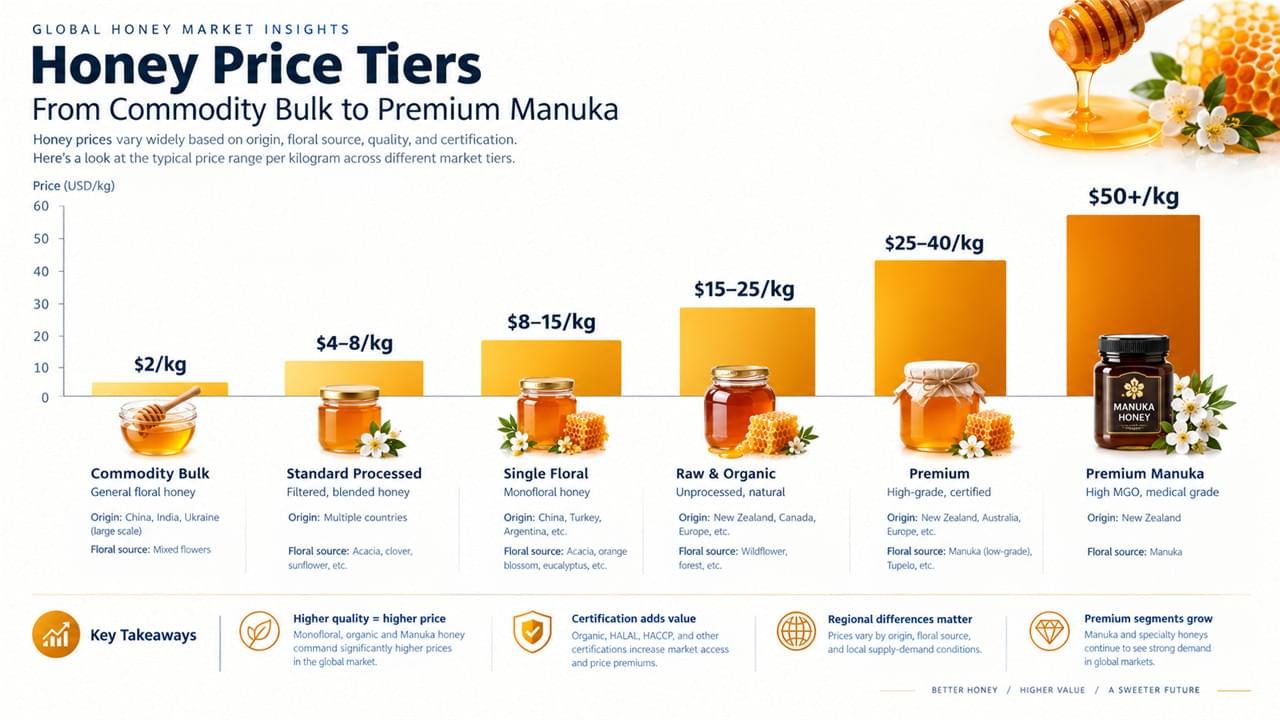
There’s no exchange-traded honey price. Deals are negotiated bilaterally, so the honest answer to “what does honey cost?” is a set of tiers, not a single number. Here’s the 2024–2025 market framework for bulk honey price 2026 planning:
| Grade/Type | FOB Price Range (USD/kg) | Notes |
|---|---|---|
| Commodity multi-origin (China) | $1.80–2.80 | Volume benchmark; quality variable |
| Commodity (South American) | $2.20–3.50 | Argentina, Brazil; EU-compliant grades |
| Standard European origin | $3.50–5.50 | EU domestic production premium |
| Organic certified (any origin) | $3.50–6.50 | 50–100% premium over conventional |
| Premium monofloral (acacia, linden) | $5.00–12.00 | Origin and varietal premium |
| Manuka (NZ, UMF rated) | $20–100+ | Premium nutraceutical category |
| Sidr (Yemen/Saudi) | $15–50+ | Ultra-premium gift/luxury |
Treat these ranges as orientation, not quotes. Actual negotiated prices move with volume, specification, lead time, and — more than buyers like to admit — the strength of the supplier relationship. A USDA honey market summary is a useful secondary check on US-side pricing sentiment.
🏆 Quality Tiering in the Global Honey Market: What Buyers Pay For
The premium between tiers isn’t marketing margin — it reflects real, structural cost differences. Three examples worth knowing cold:
Why organic honey costs more: annual farm certification inspections, careful foraging-zone and apiary placement, lower yields per hive under organic management, and a documentation burden that never really ends.
Why monofloral honey commands a premium: precision apiary management during bloom, narrow harvest timing windows, pollen analysis verification, and production that’s simply limited by what flowers when.
Why testing-compliant honey has a floor price: a pesticide panel runs roughly 150–300pershipmentandantibiotictestinganother150–300pershipmentandantibiotictestinganother100–200. Those costs are baked into every compliant quote — which is why a price far below the tier range usually means testing was skipped somewhere. For the full certification landscape behind these tiers, see our Quality Standards and Certifications guide.
🛃 Market Access: The Rules That Gate Each Market
Getting honey across a border is where many deals stall, because each major market writes its own gate:
EU honey import requirements: GACC registration for Chinese exporters, a health certificate from the origin authority, pesticide residue compliance against EU MRLs (among the world’s strictest), and zero-tolerance antibiotic screening for substances like chloramphenicol.
US import requirements: FDA facility registration, prior notice to FDA, FSVP compliance carried by the importer, and country-of-origin labeling.
Japan import requirements: a Japan-specific pesticide panel (JAS MRLs differ from the EU), strict antibiotic requirements, and a strong preference for ISO/FSSC-certified suppliers.
None of these are exotic — but each one is a document you either have ready or a container you don’t. For varietal-level detail on what you’re actually sourcing, our Honey Varieties and Production Guide breaks down the types behind the grades.
🤝 The Bottom Line for 2026 Buyers
The global honey market rewards preparation: know your origins, price against the right tier, and clear market access before the cargo does. If you’re mapping 2026 procurement and want a second pair of eyes on compliance documentation for a specific destination market, we’re happy to help.
 English
 Arabic
 French
 German
 Portuguese
 Russian
 Spanish
 Japanese
 Korean