
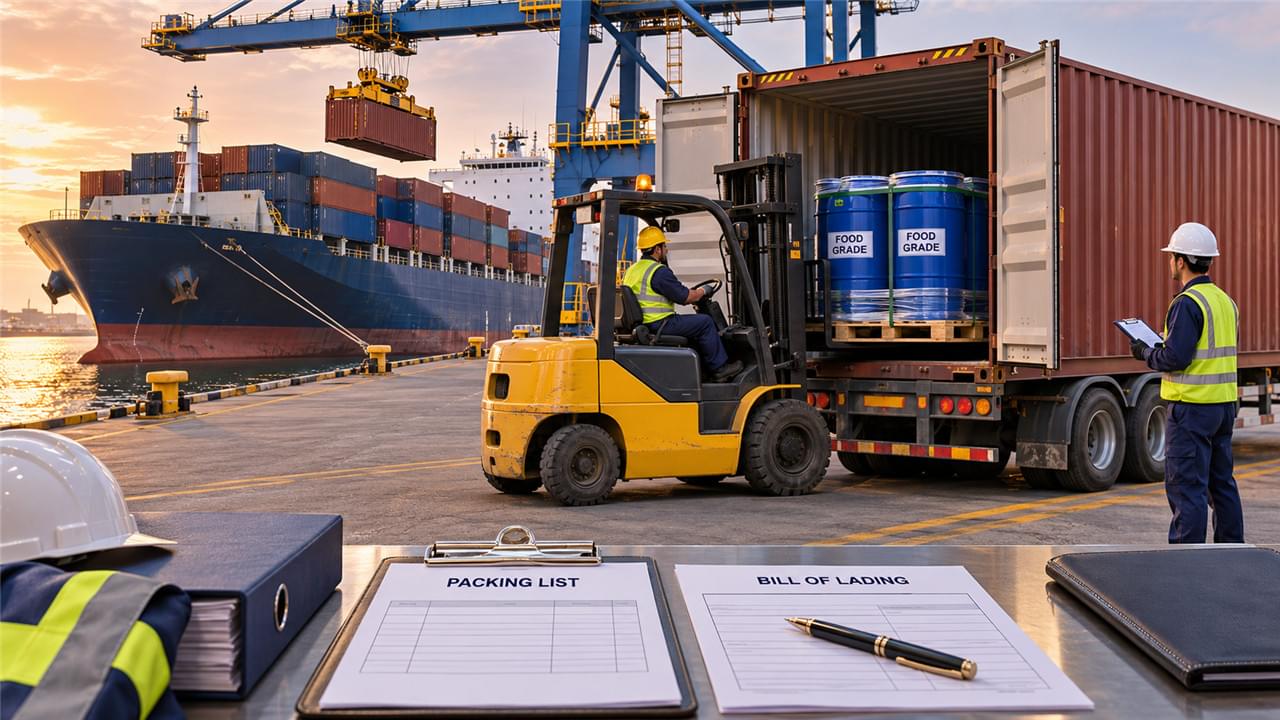
Honey import logistics starts at origin and continues until the shipment reaches your facility. A damaged seal, a paperwork discrepancy, prolonged heat exposure, or a customs delay can put a shipment at risk even when it leaves a reliable supplier in perfect condition. Give packaging, documentation, transit conditions, and customs clearance the same scrutiny you give supplier selection.
This guide covers the operational essentials: packaging formats, the document set, lead times, and the four risks that sink most shipments. For the sourcing decisions upstream of all this, start with the Global Honey Sourcing Guide.
Table of Contents
Toggle🌍 Why Honey Import Logistics Is Where Good Sourcing Goes Wrong
Here’s the uncomfortable pattern: buyers invest weeks qualifying a supplier, then hand the shipment to whichever forwarder quoted lowest. Honey punishes that. It absorbs odors, it sets in cold weather, its documentation requirements vary by market, and a two-week customs hold can turn a just-in-time ingredient line into a reformulation project. Treat honey import logistics as a designed system — packaging, paperwork, transit, and clearance planned together — and most of the classic failures simply don’t happen.
📦 Bulk Honey Packaging and Container Requirements
The packaging decision drives everything downstream — cost per kilo, handling at your facility, and contamination exposure:
| Format | Net Content | Liner Requirement | Typical Use |
|---|---|---|---|
| Steel drum 200L | ~280 kg net | Epoxy or PE inner liner | Standard bulk EU/US |
| HDPE drum 200L | ~280 kg net | No liner needed | Alternative; food grade |
| IBC (Intermediate Bulk Container) | ~1,000–1,400L | Food-grade liner | High-volume; reduces per-unit cost |
| Flexitank | 14,000–24,000L | Single-use flexible liner | Ultra-high volume; not all origins |
| Pail 20L | ~28 kg | PE lid seal | Secondary bulk; foodservice |
On receipt, verify before signing anything: drum lids sealed with no evidence of tampering, liners intact (no punctures or seam failures), drum labels matching the Commercial Invoice and CoA lot numbers, no leakage or damage — and on premium shipments, thermal labels indicating transit temperature. Photograph everything at unloading; a timestamped photo is worth more in a claim than a paragraph of email.
🧾 Honey Customs Documentation: Where Most Honey Import Logistics Delays Are Born
Missing or inaccurate paperwork is the primary cause of customs delays in honey import logistics — and it’s fully preventable, because the document set is fixed. Verify completeness before cargo departs origin:
| Document | Purpose | Who Issues |
|---|---|---|
| Commercial Invoice | Customs value declaration | Exporter |
| Packing List | Contents verification | Exporter |
| Bill of Lading / Air Waybill | Freight contract; title transfer | Freight forwarder / carrier |
| Certificate of Origin | Preferential duty; country verification | Origin chamber of commerce |
| Health Certificate | Food safety compliance | Origin government authority |
| Certificate of Analysis | Product specification compliance | Exporter / third-party lab |
| Third-party test reports | Pesticide, antibiotic, adulteration | Accredited laboratory |
| HALAL certificate | Market access (GCC, others) | Certification body |
| Organic certificate | Organic claim verification | Certifying body |
| GACC registration (China) | EU import requirement | GACC |
The market-specific rules behind several of these — health certificates, HALAL gates, positive-list testing — are decoded market by market in our honey import regulations guide.
🚢 Shipping Modes and Lead Time Planning
| Route | Sea Freight (FCL) | Air Freight | Notes |
|---|---|---|---|
| China → Rotterdam | 22–30 days | 3–5 days | Most common EU route |
| China → Los Angeles | 14–18 days | 3–5 days | US West Coast |
| Argentina → Hamburg | 20–25 days | 4–7 days | South America to EU |
| New Zealand → Japan | 12–16 days | 3–4 days | Asia-Pacific route |
Add a 5–10 day buffer to every estimate for customs clearance, document verification, and port handling. In practice: 4–6 weeks minimum procurement lead time, 8–12 weeks for stable supply planning. Air freight exists for emergencies and premium products — at honey’s price point, sea freight is the planning default, and the calendar matters more than the carrier.
⚠️ Four Risks That Break Honey Import Logistics
Risk 1: Port congestion. Rotterdam, Los Angeles, and Shanghai all experience periodic gridlock; 2–4 week delays at peak are normal, not exceptional. Monitor public port congestion data, hold a 4–6 week safety stock, and keep alternative port options for critical shipments.
Risk 2: Documentation failure. The fix is unglamorous: pre-departure review against the table above, a forwarder who actually knows honey import requirements, and GACC status verified before the container leaves.
Risk 3: Contamination in transit. Honey absorbs odors — co-loading near chemicals or odorous cargo can compromise a full container. Specify “food-grade container, clean and dry” in shipping instructions, inspect and photograph the container before loading, and refuse dubious co-loading arrangements.
Risk 4: Price volatility. Harvest conditions, currency swings, and supply disruptions all move prices. Forward contracts lock volume pricing; diversifying across origins with complementary seasonal calendars — the counter-seasonal Argentina advantage covered in our supply chain outlook — smooths the rest.
🛃 Customs Compliance: Four Problems to Avoid
- Incorrect HTS classification: natural honey is 0409.00; filtered honey may classify differently in some markets — verify with the EU customs tariff database or FDA import procedures for your destination.
- Anti-dumping evasion: transshipping through third countries to dodge AD duties is illegal — and it puts your company name on the violation, not just your supplier’s. Verify certificates of origin are genuine.
- Under-valuation: prices far below market benchmarks trigger customs queries. Invoice actual transaction value.
- Labeling non-compliance: pre-clear labeling with a customs consultant before the first shipment into any new market — the quality standards framework lists what each market expects on the label.
🧭 Build the Honey Import Logistics Plan Before You Need It
The best time to design your honey import logistics is before the purchase order, not during a customs hold: packaging format matched to your facility, the document set verified at origin, buffers built into the calendar, and contingencies named for each of the four risks. Delimfg’s export team handles standard market documentation on every shipment — buyers supply the specification, we supply the paperwork discipline.


 English
 Arabic
 French
 German
 Portuguese
 Russian
 Spanish
 Japanese
 Korean