
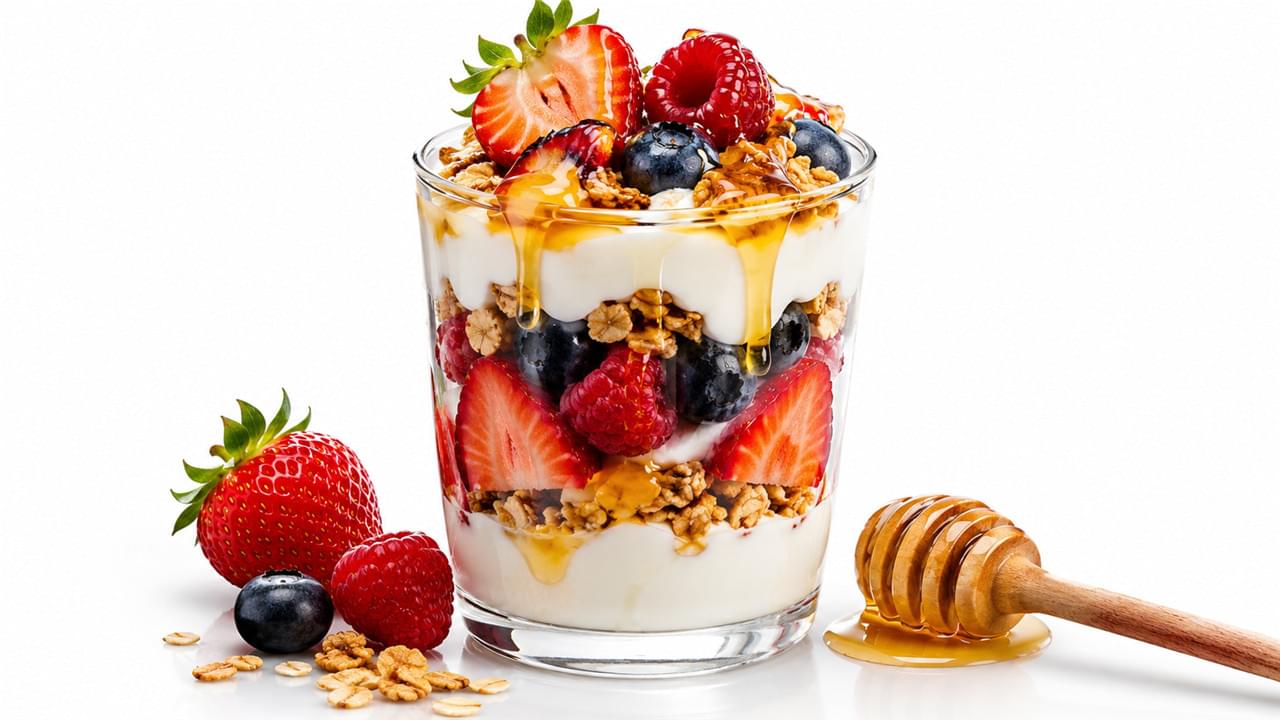
Dairy is the most chemically sensitive arena for natural sweeteners — live cultures, milk proteins, and fat all react to what you add and when you add it. Get dairy sweetener formulation right, and honey, agave, and maple syrup stop being a label gamble and start being the premium story shoppers on refrigerated and frozen aisles are actively hunting for. Get it wrong, and you stun your cultures, sand up a pint, or haze a clear pack. These seven rules distill the dosage tables, timing decisions, and freezing physics that separate a clean-label dairy win from an expensive reformulation cycle.
⭐ The short version: dose honey by culture tolerance, add it after fermentation where the process allows, exploit freezing point depression in frozen desserts, and switch to agave or maple the moment vegan certification enters the spec.
🥛 Yogurt and Cultured Dairy: Where the Cultures Set the Limits
🧪 Rule 1: Dairy Sweetener Formulation Starts With the Culture Table
Honey’s antimicrobial reputation is earned, but its impact on Lactobacillus bulgaricus and Streptococcus thermophilus is concentration-dependent — and routinely overstated on the factory floor. The working numbers:
| Honey Concentration | Impact on LAB |
|---|---|
| 1–3% w/w | No significant inhibition; fermentation proceeds normally |
| 3–5% w/w | Slight inhibition; extend fermentation time by 10–15% |
| 5–8% w/w | Moderate inhibition; pre-pasteurization addition recommended |
| >8% w/w | Significant inhibition; post-fermentation addition only |
Read that table before you book the tanks, not after — it’s the cheapest insurance in dairy sweetener formulation. Below 3% w/w, nothing changes. Between 3% and 5%, budget a longer fermentation. Above 8%, don’t fight the biology — post-fermentation addition is the only sensible answer, which is exactly why Rule 2 exists.
⏱️ Rule 2: Honey in Commercial Yogurt Production Is a Timing Decision
Two proven routes, and the choice is about process order, not courage:
- Standard honey yogurt: add honey at 2–4% post-fermentation, as a swirl or a through-blend. Full flavor impact, zero culture risk.
- Honey-set yogurt: use ≤3% pasteurised honey added to cold milk before fermentation — the fruit-at-the-bottom style consumers associate with premium positioning.
Either way, honey in commercial yogurt production rewards teams that treat addition point as a dairy sweetener formulation variable with the same seriousness as the dose itself. Fermentation guidelines from the International Dairy Federation back the same logic: protect the culture first, build flavor second.
🍯 Rule 3: Match the Honey Variety to the Flavor Target
The variety decision shapes the consumer experience more than any rheology tweak:
- Acacia honey: mild and floral — the versatile default, pairs with any fruit or plain profile
- Clover honey: mild-medium sweetness — the workhorse for children’s yogurt lines
- Manuka honey: strong and distinctive — premium swirl topping, not a base sweetener
- Buckwheat honey: robust, molasses-like — suited to savory-leaning and grain-based yogurts
🌿 Rule 4: Agave Wins High-Protein Dairy Sweetener Formulation
Greek-style and high-protein yogurt bases don’t need another loud flavor competing with the protein character. Agave nectar’s clean, neutral profile acts as pure sweetening power — at 4–6% inclusion it delivers consumer-preferred sweetness without honey’s floral signature. That predictability is what makes high-protein dairy sweetener formulation boring, in the best possible way: no flavor interference, no culture inhibition at working doses, no surprises in sensory panels. For the full chemistry, see our agave nectar properties guide.
🍦 Ice Cream and Gelato: Let Freezing Physics Do the Work
🍦 Rule 5: Dairy Sweetener Formulation and the Scoopability Equation
The functional superpower of honey and liquid sweeteners in frozen desserts is freezing point depression — the single biggest lever on serving hardness. Fructose and glucose carry higher osmotic activity than sucrose molecule for molecule, so each gram contributes more depression per gram of sweetener:
| Sweetener | Freezing Point Depression (vs Sucrose = 1.0) |
|---|---|
| Honey | 1.3–1.5× |
| Agave Nectar | 1.4–1.6× |
| Invert Sugar Syrup | 1.2–1.4× |
| Maple Syrup | 0.9–1.1× |
| Coconut Sugar | 0.8–0.9× |
The practical payoff in dairy sweetener formulation: replacing 25–50% of sucrose with honey or agave improves natural sweetener ice cream scoopability at typical serving temperatures (−12 to −16°C) — no added antifreeze agents, no label compromise.
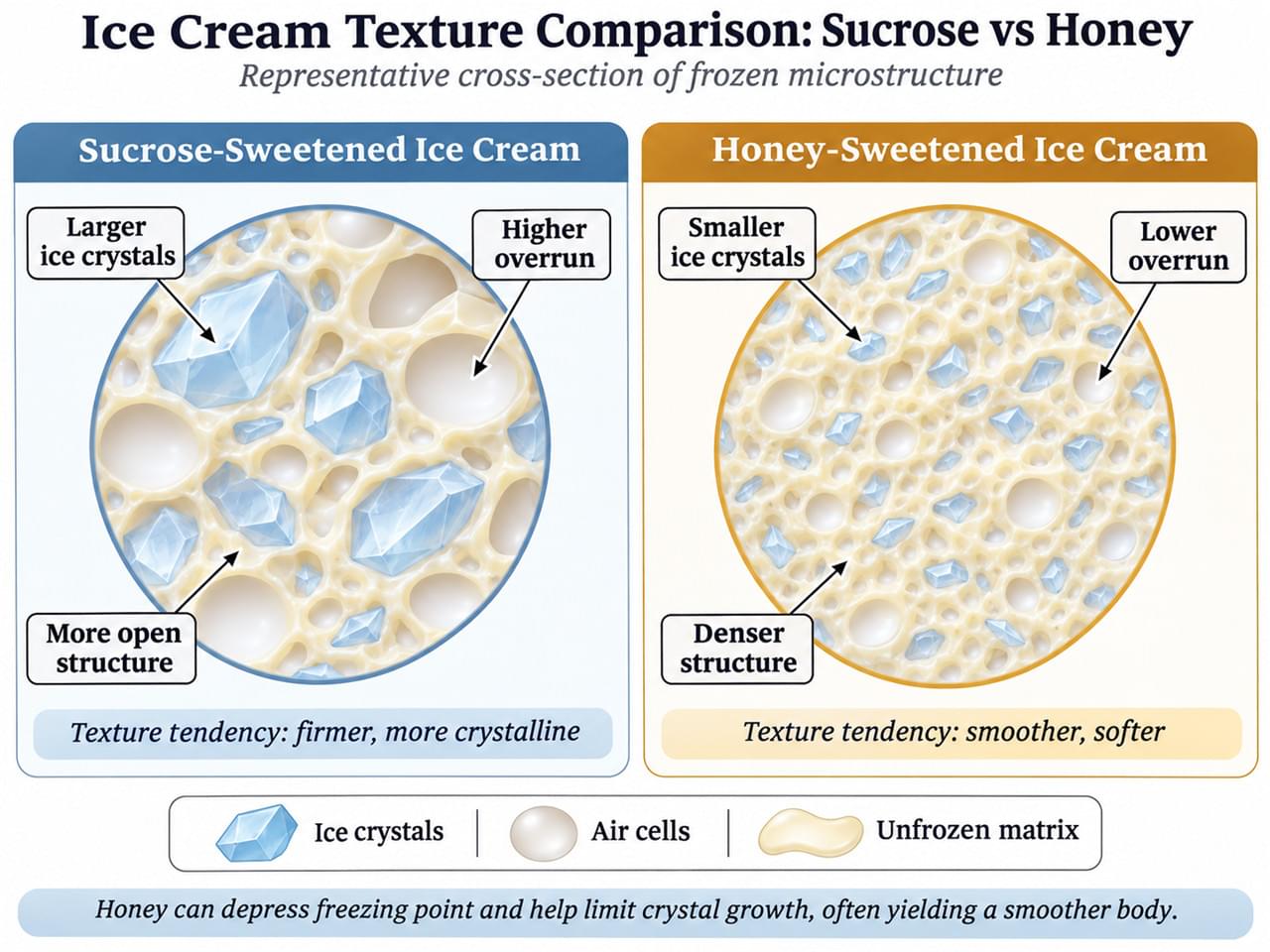
⚖️ Rule 6: Validate Overrun in Dairy Sweetener Formulation Trials
Honey’s protein fraction and agave’s slightly higher viscosity can marginally affect air incorporation during freezing. Below 50% replacement it’s usually noise, but “usually” is not a scale-up argument. Run the substitution protocol:
- Start at 25% sucrose replacement
- Evaluate texture and hardness at −12°C and −18°C
- Move to 50% replacement only if hardness holds
- Never exceed 60% without compensating stabiliser adjustment
Peer-reviewed work in the Journal of Dairy Science is blunt on this point: frozen dessert systems punish unvalidated shortcuts more than almost any other dairy category.
🍧 Rule 7: Sorbets Put Sweetener Flavor on Display
With no dairy fat to buffer it, sweetener flavor is fully exposed — which is precisely the opportunity. Target 28–30°Brix in the mix before freezing, use light varieties (acacia, orange blossom) for fruit sorbets, and reserve chestnut or buckwheat for standalone honey sorbet where the flavor is the product. Honey sorbets command premium pricing because the character is unmistakable — a text-book clean-label claim.
🧀 Cheese Spreads and Plant-Based Swaps: The Short Version
Fresh Cheese, Ricotta, and Cream Cheese Spreads
Honey pulls double duty in fresh cheese: at flavoring concentrations (2–8%) its antimicrobial activity can marginally extend shelf life by inhibiting surface mold — and where it replaces potassium sorbate or natamycin, that’s a genuine clean-label claim, not marketing poetry. For spreads, warm the honey to 35–40°C for blendability with cold cream cheese, target 8–15% for prominent honey flavor, and keep date syrup or maple syrup in reserve for premium seasonal variants. The sugar matrix behind these behaviors is covered in our honey composition guide.
🌱 Plant-Based Dairy Sweetener Formulation Plays by Vegan Rules
Honey is not vegan — full stop. The moment vegan certification enters the dairy sweetener formulation spec, maple syrup, agave nectar, and date syrup take over. Coconut sugar and maple pair naturally with oat and nut base flavors, while agave’s clean profile and viscosity match plant-based yogurt structures well. In the freezer case, agave nectar in frozen dessert formulation is the strongest card: high freezing point depression keeps almond- and oat-based pints scoopable without flavor dominating the base.
✅ The Bottom Line
Dairy rewards precision. Dose honey against the culture table, time the addition around fermentation, exploit freezing point depression where texture is money, and respect vegan boundaries in plant-based lines. Manufacturers that benchmark their dairy sweetener formulation against our full natural sweetener formulation guide walk into pilot trials with the answers half-written — and walk out with a clean-label product that earns its premium shelf placement.
 English
 Arabic
 French
 German
 Portuguese
 Russian
 Spanish
 Japanese
 Korean