
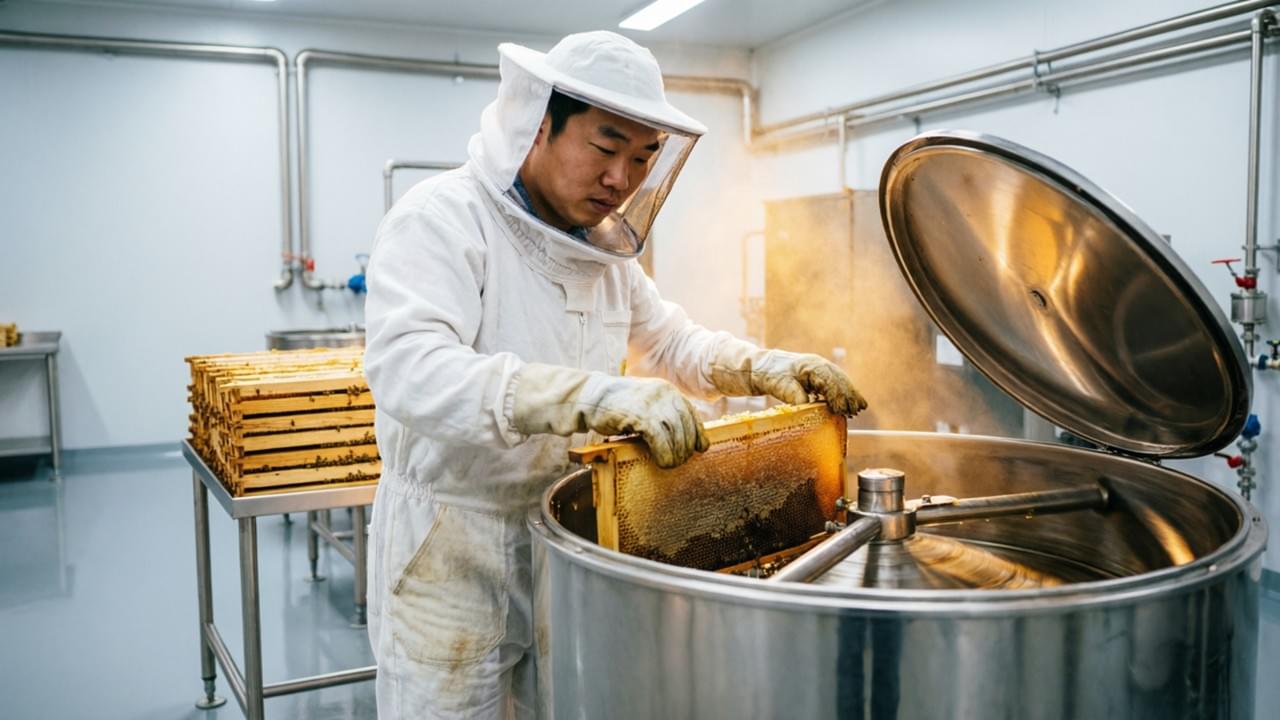
For importers, food manufacturers, and private-label brands, understanding honey production processing is far more than a technical exercise. Every step—from hive management to final packaging—directly influences honey quality, authenticity, shelf life, and regulatory compliance.
Whether you are sourcing industrial ingredients or evaluating suppliers within the global bulk honey supply chain, knowing how honey is produced helps you make smarter purchasing decisions and reduce supply risks.
In this guide, we’ll explore the five key stages that transform nectar collected by bees into commercial honey ready for international markets.
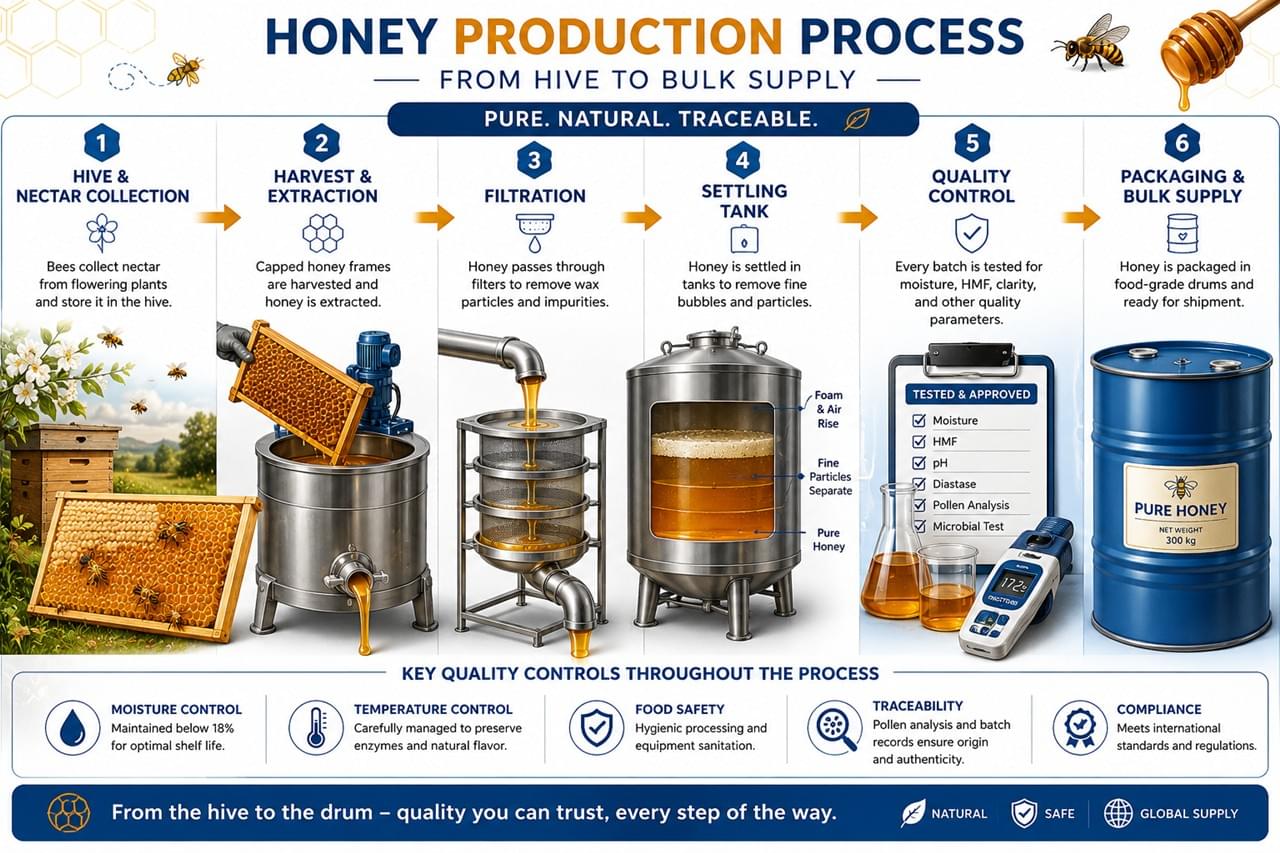
🐝 Stage 1: Honey Production Processing Begins in the Apiary
Colony Health Determines Honey Quality
Successful honey production processing starts long before extraction equipment enters the picture. It begins with healthy and productive bee colonies.
Commercial beekeepers carefully monitor colony strength, queen performance, and disease prevention programs. One of the most significant challenges worldwide is controlling Varroa mites, parasites that weaken bee colonies and can negatively impact production.
Modern producers typically implement Integrated Pest Management (IPM) strategies, combining monitoring, preventive measures, and documented treatments to maintain healthy hives while ensuring traceability.
Nectar Collection and Natural Ripening
The floral source surrounding an apiary has a direct influence on honey characteristics. Bees typically forage within a radius of 1–3 kilometers, making apiary location critical for producing specific monofloral honey varieties.
As nectar is brought back to the hive, bees naturally reduce moisture levels while adding enzymes such as invertase and glucose oxidase. Once moisture reaches a stable level, bees seal the honeycomb cells with wax caps, signaling that the honey is mature and ready for harvest.
For a deeper understanding of floral origins, explore our guide on Honey Varieties and B2B Guide.
🍯 Stage 2: Honey Production Processing Through Harvest and Extraction
Choosing the Right Harvest Time
Timing plays a crucial role in honey production processing.
Professional producers generally wait until at least 80% of honeycomb cells are capped before harvesting. This helps ensure moisture levels remain low enough to prevent fermentation.
Many operations also use digital refractometers to verify moisture content before extraction. Premium-grade honey is typically maintained below 18% moisture.
Modern Honey Extraction Methods
Among commercial honey extraction methods, centrifugal extraction remains the industry standard.
The process involves:
✅ Removing wax caps from honeycomb frames
✅ Loading frames into extractors
✅ Using centrifugal force to separate honey from comb cells
✅ Collecting honey through coarse filtration screens
This method preserves the comb structure, allowing beekeepers to reuse frames while improving operational efficiency and sustainability.
🔍 Stage 3: Honey Production Processing and Filtration
Why Filtration Matters
After extraction, honey contains wax particles, air bubbles, pollen, and other natural materials. Filtration improves appearance and consistency while preparing honey for commercial use.
Different filtration levels serve different markets:
- Coarse filtration for raw honey products
- Standard filtration for retail and foodservice applications
- Fine filtration for industrial manufacturing
- Ultra-fine filtration for highly clarified products
However, excessive filtration can remove pollen, which is often used to verify geographical and botanical origin.
Managing Heat During Processing
Temperature management is one of the most sensitive aspects of honey production processing.
Carefully controlled heating helps:
- Improve flow characteristics
- Simplify filtration
- Prevent fermentation
- Delay crystallization
Excessive heat, however, may reduce enzyme activity and increase Hydroxymethylfurfural (HMF), a recognized indicator of heat exposure and product aging.
International standards such as the Codex Alimentarius Honey Standard recommend maintaining HMF levels within accepted limits for global trade.
💧 Stage 4: Honey Production Processing and Moisture Control
The Importance of Honey Moisture Content Control
One of the most important quality indicators is honey moisture content control.
Honey with excessive moisture can ferment during storage or transportation, leading to quality issues and financial losses.
Professional suppliers use several methods to reduce moisture when necessary:
- Controlled dehumidification rooms
- Temperature-regulated storage systems
- Forced-air drying technologies
Most premium suppliers aim for moisture levels below 18%, while some maintain levels around 17% for maximum stability.
Proper moisture management is especially important for exporters serving humid climates or handling long shipping routes.
For additional quality indicators, see our article on Honey Quality Standards and Testing.
📦 Stage 5: Honey Production Processing Before Bulk Packaging
Settling and Blending
Before packaging, honey is transferred into settling tanks where it rests for 24–72 hours.
During this period:
✔ Air bubbles rise to the surface
✔ Fine particles separate naturally
✔ Product appearance improves
Many commercial suppliers also blend multiple batches to achieve consistent color, flavor, and moisture specifications throughout the year.
Packaging for Global Distribution
The final step in honey production processing is packaging.
Common export formats include:
🥫 Steel Drums (300 kg)
🪣 Food-Grade Plastic Pails (25 kg)
🏭 Intermediate Bulk Containers (IBC)
📦 Customized industrial packaging
All packaging materials must comply with destination market food-contact regulations.
Businesses involved in international sourcing can learn more from our Global Honey Sourcing Guide.
📋 Documentation Every Buyer Should Request
Reliable suppliers should provide comprehensive documentation with every shipment, including:
✅ Certificate of Analysis (CoA)
✅ Third-party laboratory reports
✅ Batch traceability records
✅ Harvest and production documentation
✅ Organic, Halal, or Kosher certifications where applicable
✅ Pollen analysis reports when origin verification is required
These documents help buyers verify product authenticity, regulatory compliance, and supply chain transparency.
🌍 Why Understanding Honey Production Processing Matters
The quality of bulk honey is determined by every stage of production—from colony management and nectar collection to filtration, moisture control, and packaging.
For B2B buyers, understanding honey production processing provides valuable insight into supplier capabilities, quality consistency, and long-term reliability.
The best suppliers do more than deliver honey. They provide traceability, technical documentation, quality assurance, and transparent production practices that support sustainable business growth.
As global demand for natural sweeteners continues to grow, choosing a supplier with a well-managed production process remains one of the smartest investments a buyer can make.
 English
 Arabic
 French
 German
 Portuguese
 Russian
 Spanish
 Japanese
 Korean