
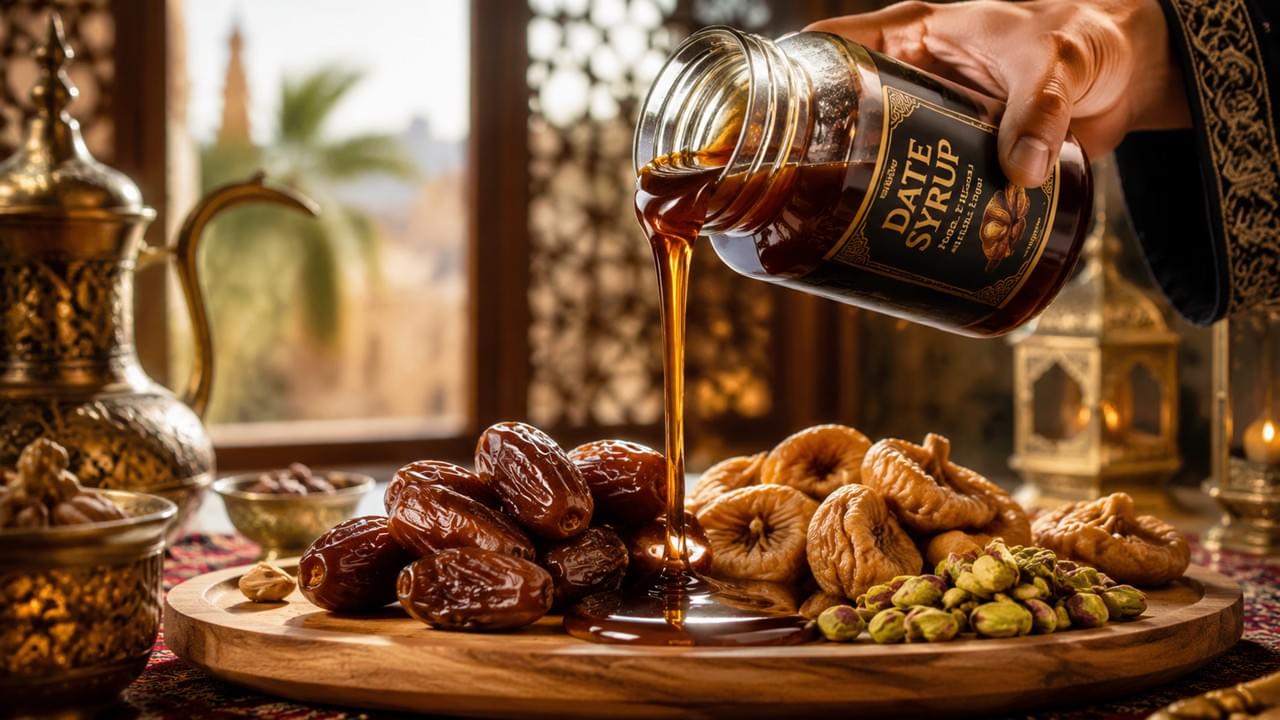
Date syrup has been made in the Middle East and North Africa for more than 5,000 years, and Western food brands are finally catching on. The reason isn’t nostalgia. For buyers weighing a switch, date syrup for food manufacturing brings four things to the table: antioxidant richness, a moderate glycemic index, natural HALAL compliance, and a consumer perception that marketing can’t fake. Here’s what’s behind each one — and how to buy it without surprises.
⭐ Why Date Syrup for Food Manufacturing Is Trending
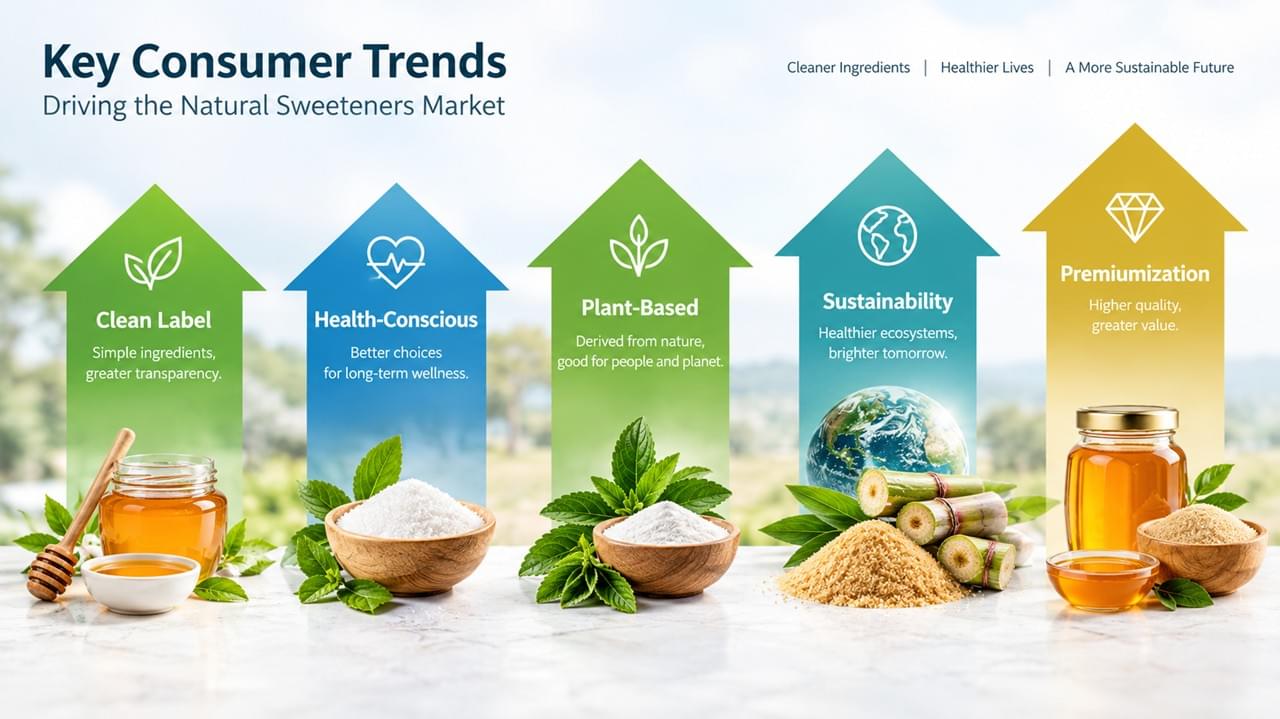
Clean-label pressure is rewriting sweetener shortlists, and date syrup answers with one of the simplest decks you can print on a label: date extract, period. No sulfites, no enzymes, no synthetic preservatives — just fruit, water, heat, and time. For brands shortlisting ingredients, date syrup for food manufacturing ticks boxes that refined options can’t.
There’s a perception angle too. Dates carry a genuinely positive health halo, and the rise of MENA cuisine in Western retail — hummus, za’atar, baklava — has normalized date-sweetened products on mainstream shelves. That’s a rare combination: a sweetener that tastes familiar yet tells a story.
For the wider picture on where demand is heading, our Global Market Trends in Natural Sweeteners breaks down the category numbers, while the Natural Syrups and Alternative Sweeteners Guide maps every liquid sweetener you might compare against.
🏭 How Date Syrup Is Made
🥄 How Date Syrup for Food Manufacturing Is Produced
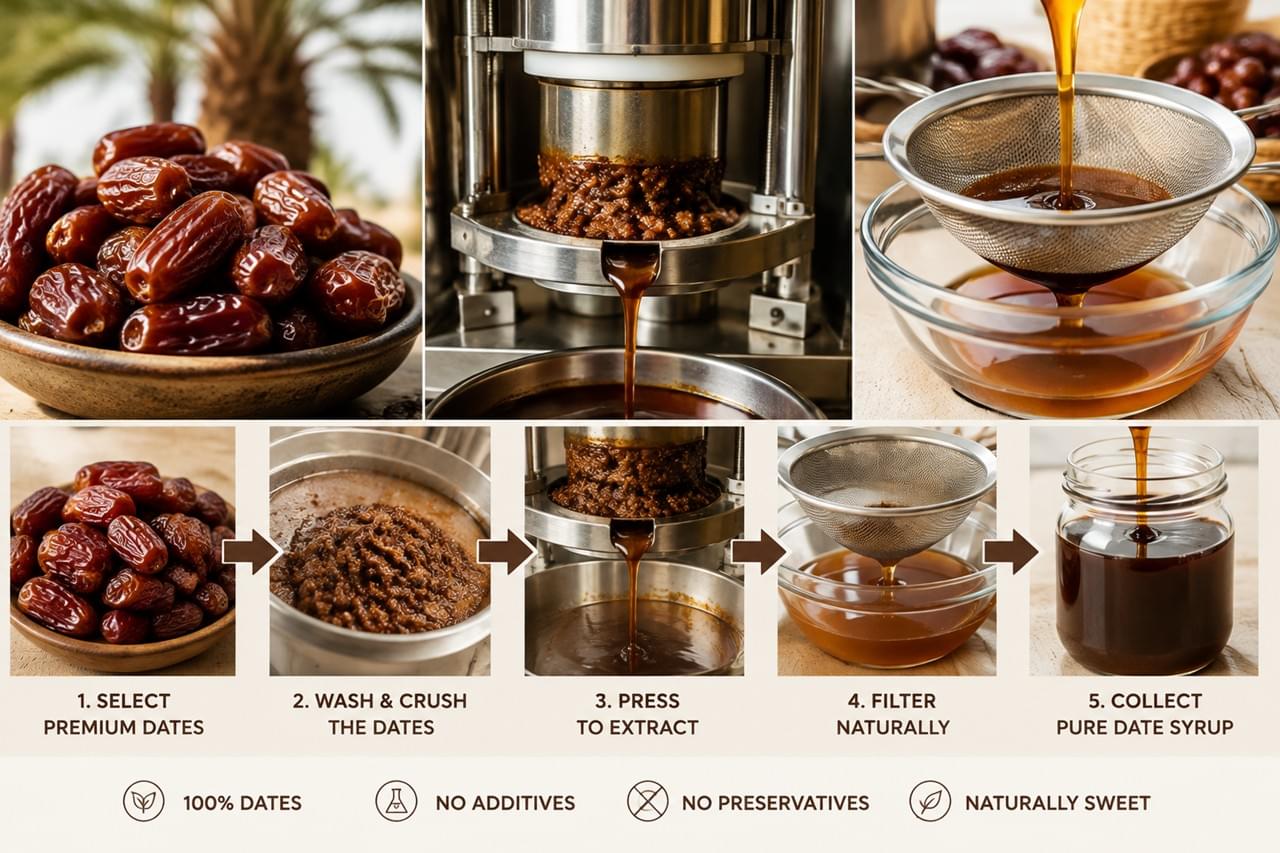
Commercially, the process is refreshingly low-tech:
- Washing and pitting Medjool, Deglet Noor, or other commercial date varieties
- Cooking in water to pull out the soluble compounds
- Pressing and straining to separate the solids
- Concentrating by evaporation to a target Brix of 65–75°
Nothing chemical happens at any step. That mechanical, heat-only process is what makes date syrup one of the cleanest-label liquid sweeteners you can buy.
Origin matters for both price and authenticity. Iraq remains the largest historical producer, with Saudi Arabia, Iran, Algeria, the UAE, and Tunisia close behind; premium Medjool syrups from Jordan and the UAE command the top prices.
📊 Nutrition and Flavor: What Date Syrup Delivers
🧪 Antioxidants and Glycemic Index: The Numbers
One tablespoon (about 21 g) looks like this:
| Nutrient | Per 1 tbsp (~21g) | Notes |
|---|---|---|
| Calories | ~50–60 kcal | Similar to honey |
| Total sugars | 11–13 g | Glucose, fructose, sucrose roughly equal thirds |
| Glycemic Index | ~40–55 | Moderate — lower than honey, similar to maple |
| Iron | ~1–2% DV | Modest but present |
| Potassium | ~4–5% DV | Notable |
| Magnesium | ~3% DV | Moderate |
| Antioxidants | High | Among the highest of liquid sweeteners |
| Dietary fiber | Trace (~0.5 g/tbsp) | Minimal after straining |
Two numbers do most of the heavy lifting. The date syrup glycemic index sits around 40–55 — moderate, lower than honey, close to maple — which matters for sugar-conscious positioning. Published values are tracked in the glycemic index data for date products.
On antioxidants, date syrup ranks among the highest of liquid sweeteners: DPPH scavenging comparable to dark maple syrup, with protocatechuic, ferulic, and caffeic acids plus quercetin derivatives in the phenolic lineup. The date syrup antioxidant research review is a solid place to build your claim file.
Want the honey side of that comparison? Health and Nutritional Impacts of Natural Sweeteners and Honey Quality Standards and Certifications cover the nutrition and the spec checks.
😋 Choosing Date Syrup for Food Manufacturing by Flavor and Function
Four properties decide where date syrup for food manufacturing fits:
- Flavor — rich, caramel-like, faintly fruity, with toffee and dried-fruit notes; less assertive than molasses, more complex than agave.
- Viscosity — thick, roughly honey-like; a little thinner than blackstrap at equal Brix.
- Color — deep amber to dark brown; it will tint light-colored formulations.
- Sweetness — about 0.9–1.0× sucrose, so plan a small formula adjustment when swapping.
🍽️ Top Applications of Date Syrup for Food Manufacturing
🥙 Middle Eastern Classics Going Global
Date syrup is the authentic backbone of a wave of regional products now crossing into Western retail: tahini-date hummus variants, dressings, and dips; pomegranate-date and tamarind-date sauces; and real dessert bases like baklava filling and ma’amoul cookies. If your range serves that trend, there’s no substitute.
🍪 Clean-Label Bakes, Bars, and Beverages
Away from MENA cuisine, date syrup does steady work in mainstream clean-label lines:
- Energy bars and granola — caramel flavor, strong binding, premium positioning
- Natural baked goods — muffins, cookies, and breads pick up moisture, color, and flavor
- Plant-based products — pairs naturally with nut butters, oats, and whole grains
- Coffee syrups and specialty drinks — date-sweetened beverages are a growing niche
Where does date syrup for food manufacturing do its best work? Those three buckets — regional, baked, and beverage.
✅ HALAL-Specific Positioning
The date syrup halal natural profile is one of its quiet selling points — pure date extract, nothing added, so certification is mostly paperwork rather than reformulation. For brands targeting GCC, Malaysia, or Indonesia, that removes processing-aid risk entirely and adds cultural resonance: dates hold a genuine place in Islamic tradition. In HALAL specialty retail, it earns premium shelf positioning almost by default.
📦 Buying Date Syrup for Food Manufacturing: What to Specify
🔢 Six Numbers to Put on Every Spec Sheet
Most of the buying decision comes down to six numbers:
| Parameter | Standard | Notes |
|---|---|---|
| Brix | 68–75° | Higher = longer shelf life, lower water activity |
| Sugar profile | Roughly equal glucose/fructose/sucrose | Consistency check across lots |
| Color | Dark amber to dark brown | Pfund equivalent |
| Sulfite-free | Confirm | For sensitive consumer groups |
| pH | 3.5–4.5 | Natural acidity |
| Origin | Iraq, Saudi, Jordan, UAE… | Verify “Medjool” claims |
Brix and sugar profile deserve the closest attention — they’re the two that drift between lots and quietly change how your formula behaves.
🤝 How to Vet a Bulk Date Syrup Supplier
Don’t chase the lowest price per tonne. A dependable bulk date syrup supplier confirms origin on paper, holds Brix steady across deliveries, and doesn’t flinch when you ask for certificates of analysis. When a “Medjool” syrup is priced like a commodity Deglet Noor, ask why.
If date syrup for food manufacturing fits your next launch, request date syrup samples and specification sheets → and we’ll help you match the right grade to your application.

 English
 Arabic
 French
 German
 Portuguese
 Russian
 Spanish
 Japanese
 Korean