
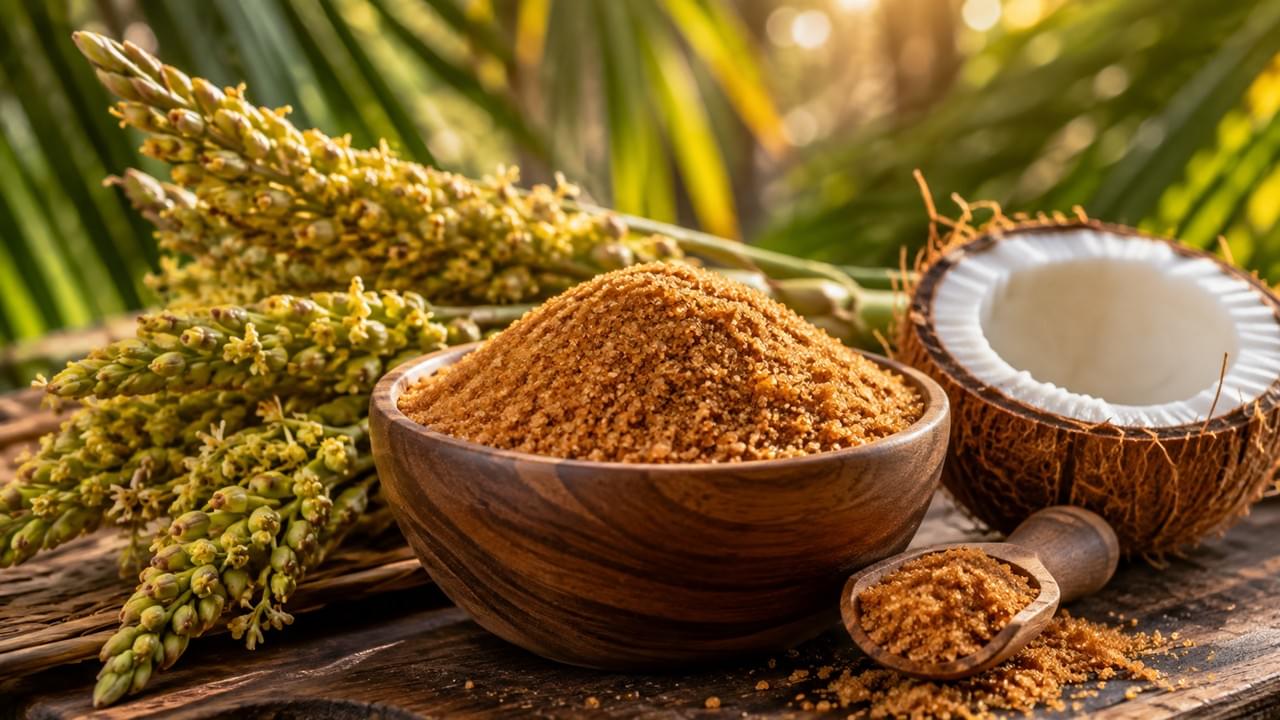
Coconut sugar has gone from a niche Asian ingredient to a fixture in Western health-food aisles in under a decade, and the hype has been loud. The interesting part is that much of it is true. For buyers looking past the marketing, coconut sugar for food manufacturing delivers three things worth paying attention to: a genuinely low glycemic index, a small but real inulin fiber content, and a one-word ingredient list. Here’s how to separate the substance from the spin — and where it actually performs.
⭐ Why Coconut Sugar for Food Manufacturing Is Trending
The success story starts with the GI number. At roughly 35, coconut sugar undercuts refined sugar by nearly half — and unlike many “low GI” claims that fall apart under scrutiny, this one has a mechanism behind it: inulin, a prebiotic fiber that slows sugar absorption. Trace minerals and a sustainability narrative complete the package.
The caveat is quality. Not every shipment labeled “coconut sugar” is the same product, and not every claim survives contact with a lab report. For where demand is heading, see our Global Market Trends; to map coconut sugar against every other option, start with the Natural Syrups and Alternative Sweeteners Guide.
🔤 Coconut Sugar vs Palm Sugar: Getting the Terminology Right
“Palm sugar” and “coconut sugar” get used interchangeably, but they’re not always the same thing:
| Term | Source | Origin | Flavor | Form |
|---|---|---|---|---|
| Coconut sugar | Coconut palm (Cocos nucifera) blossom sap | Indonesia, Philippines, Thailand | Mild caramel | Granulated, block, liquid |
| Palm sugar (coconut palm) | Same (Cocos nucifera) | Southeast Asia | Same | Same |
| Palm sugar (other palms) | Palmyra, date, Arenga palms | South/Southeast Asia | Variable, often more intense | Block, paste, liquid |
For most commercial purposes, “coconut sugar” and “coconut palm sugar” are the same product from Cocos nucifera; unqualified “palm sugar” can come from any palm, so specify the species if origin consistency matters.
🏭 How Coconut Sugar Is Made
🥄 How Coconut Sugar for Food Manufacturing Is Produced
The raw material is the sap of coconut palm flower buds, not the fruit itself:
- Tapping — flower buds are bent and tapped twice a day, yielding 1–2 liters of sap per inflorescence
- Cooking — sap is boiled in open woks to evaporate water and concentrate the sugars
- Crystallization — stirring as it cools produces the granulated crystals most buyers know
- Alternative — light cooking leaves you with coconut nectar, the liquid form
The sustainability story is genuine: palms keep producing sap without being cut down, and the same trees yield both coconuts and sugar. FAO agroforestry data on coconut production supports that, and our Sustainability and Ethics in Natural Sweeteners page digs into how it holds up.
📊 Composition, Glycemic Index, and Minerals
🧪 The Glycemic Index of Coconut Sugar for Food Manufacturing
The number that starts most conversations: the coconut sugar glycemic index comes in around 35 in the widely cited Philippine Coconut Authority study, with other papers reporting a range of 35–54. Sucrose sits near 65, honey around 55–65, agave as low as 15–30, maple near 54 — genuinely moderate territory. The Philippine coconut sugar glycemic index study is the reference to cite; for a full side-by-side, our Comparative Analysis of Natural Sweeteners lays it out.
⚗️ Sugar Composition and the Inulin Factor
The composition table explains the GI better than any marketing copy:
| Component | Level |
|---|---|
| Sucrose | ~70–80% |
| Glucose | ~3–5% |
| Fructose | ~3–5% |
| Inulin (prebiotic fiber) | 1–3% |
| Moisture (granulated) | 1–3% |
That 1–3% inulin is the mechanism: it slows glucose absorption and is partly fermented by gut bacteria instead of being absorbed as sugar. The inulin factor is what separates real coconut sugar for food manufacturing from caramel-colored cane sugar — a small number with an outsized effect, and the reason the low-GI claim is defensible rather than just trendy.
🌱 Mineral Content and the Marketing Reality
Coconut sugar is richer in minerals than refined white sugar, which contains essentially none:
| Mineral | Per 100g | vs White Sugar |
|---|---|---|
| Potassium | ~1,030 mg | Very high |
| Phosphorus | ~79 mg | Higher |
| Zinc | ~2 mg | Higher |
| Iron | ~2 mg | Higher |
| Magnesium | ~29 mg | Higher |
One honesty note for formulators: at typical application rates of 10–30 g per serving, the mineral contribution to the diet is modest, and “good source of minerals” claims only hold where your market’s thresholds allow them — verify before you print.
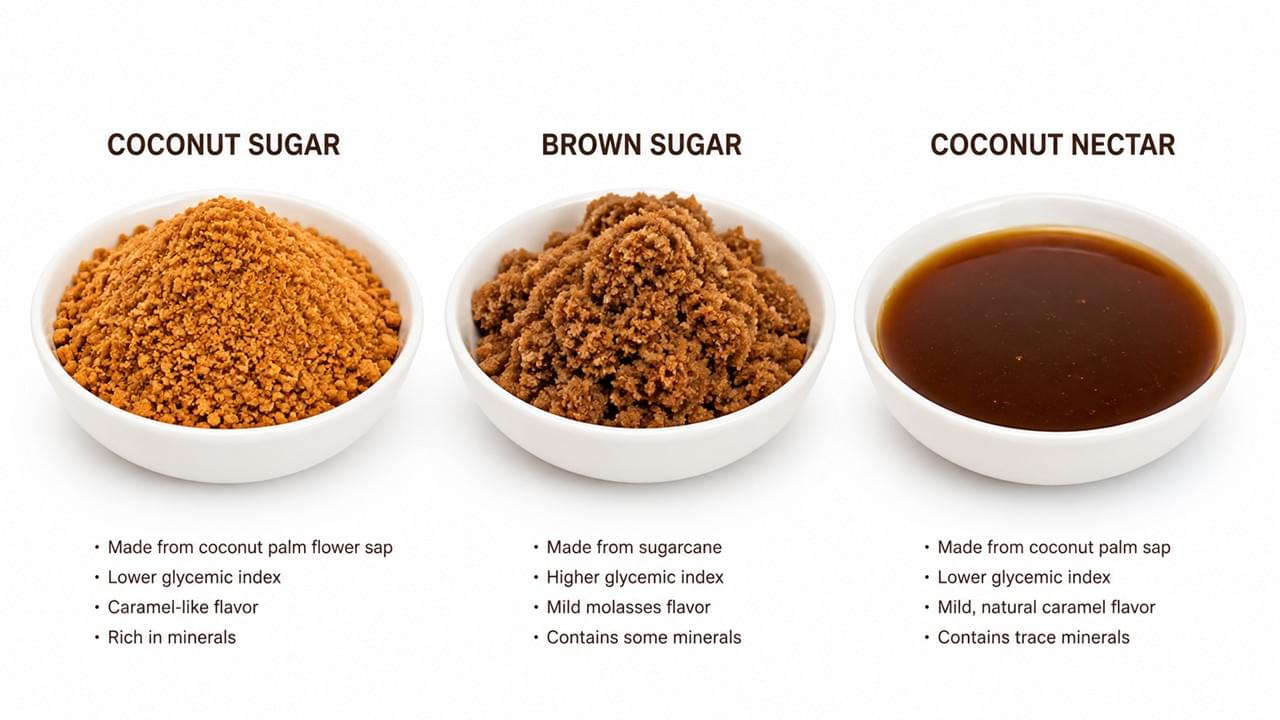
🍳 Functional Properties of Coconut Sugar for Food Manufacturing
| Property | Value | Implication |
|---|---|---|
| Sweetness vs sucrose | ~90–100% | Near 1:1 substitution |
| Color | Light to medium brown | Contributes color |
| Flavor | Mild caramel, slightly butterscotch | Distinctive, not overwhelming |
| Solubility | Good | Dissolves well in liquids |
| Hygroscopicity | Moderate | Some clumping; packaging matters |
| Granule size | Similar to brown sugar | Direct swap in baked goods |
The clean-label angle is the sleeper advantage: the ingredient list says “coconut sugar” — one word, instantly recognizable — which beats brown sugar (consumers know it’s refined) and corn syrups (they need explaining).
🍽️ Top Applications of Coconut Sugar for Food Manufacturing
🍪 Baked Goods, Snacks, and Organic Lines
For most bakery applications, coconut sugar is a near-direct brown sugar substitute — similar granule size, caramel notes, and moisture behavior, and the flavor flatters chocolate, spice, and nut systems; baked goods remain the strongest fit for coconut sugar for food manufacturing. It’s also a staple of organic granola, energy bars, and clean-label snacks — and if you’re sourcing organic coconut sugar, certification documentation matters as much as price.
🥤 Beverages and Plant-Based Products
Coconut sugar dissolves readily, so it slots easily into liquid systems: Southeast Asian-inspired drinks, bubble tea, and specialty coffee all take it well. For plant-based lines it’s a natural fit — non-animal, minimally processed, and carrying a story vegan consumers already want to hear.
📦 Buying Coconut Sugar for Food Manufacturing: What to Verify
Before you commit, three things deserve a hard look when sourcing coconut sugar for food manufacturing. First, the species: confirm Cocos nucifera, not a generic “palm sugar” from an unspecified source. Second, the GI evidence: ask which study backs the low-GI claim, and keep a copy for your claim file. Third, certification: organic claims need paper, not promises.
🤝 How to Vet a Bulk Coconut Sugar Supplier
A dependable bulk coconut sugar supplier volunteers certificates of analysis, confirms the palm species in writing, and shows organic certification before you ask twice. If a quote looks too cheap for “organic,” it probably is — origin and certs are where corners get cut.
If coconut sugar for food manufacturing fits your next launch, request coconut sugar samples and organic certification documentation → and we’ll help you match the right grade and origin.

 English
 Arabic
 French
 German
 Portuguese
 Russian
 Spanish
 Japanese
 Korean