
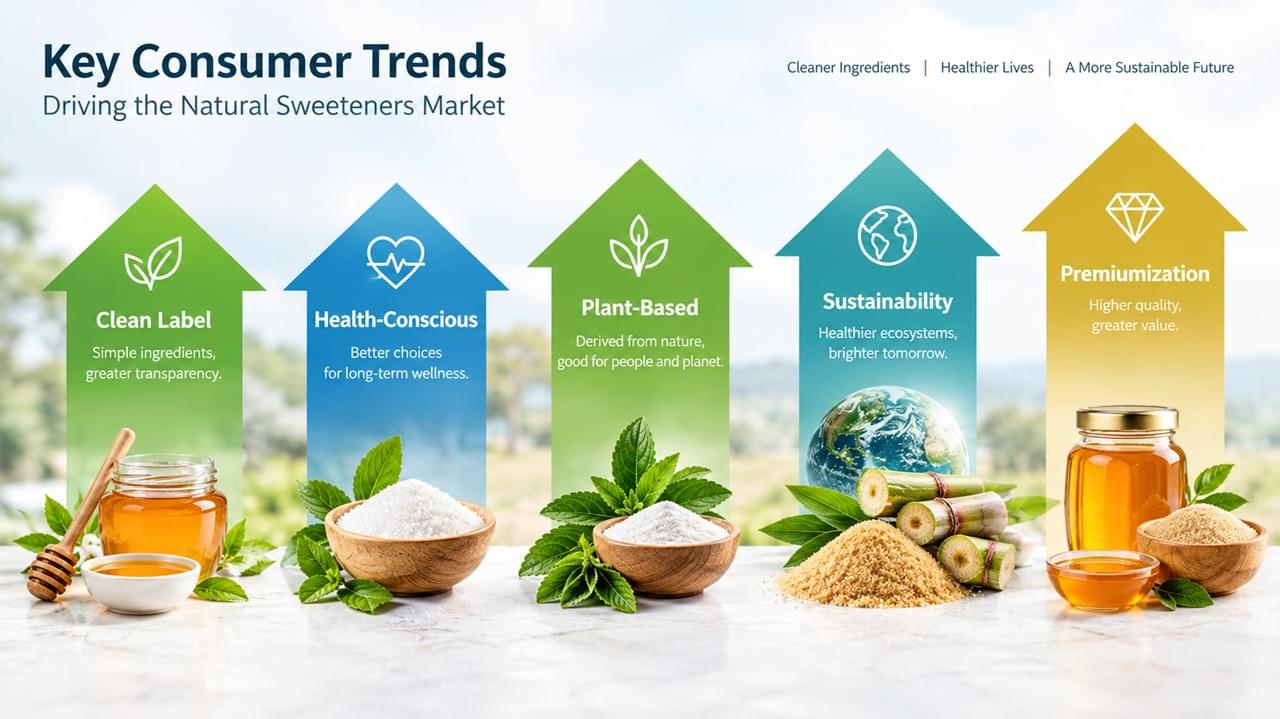
Consumer behavior is the upstream driver of every B2B ingredient decision — manufacturers reformulate when consumers shift, and consumers are shifting systematically away from artificial and highly refined sweeteners toward natural alternatives. But not every shift deserves a budget line. The real skill in reading natural sweetener demand is telling durable trends from cyclical ones, because that difference separates strategic sourcing from reactive procurement. Here are the five trends that matter in 2026, and what each one actually means for buyers.
Table of Contents
Toggle⭐ 5 Trends Shaping Natural Sweetener Demand
Quick orientation before the detail: clean label and health-conscious eating are structural and already here; plant-based growth and premiumization are compounding; sustainability is moving from nice-to-have to checkout requirement. The common thread — consumers want ingredients with a story they can verify, not just a sweetness function. For the market-size view behind these trends, see our Global Market Trends overview.
🏷️ Clean Label: The Permanent Shift in Natural Sweetener Demand
Clean-label demand — shoppers wanting recognizable, “real” ingredients — has moved from niche preference to mainstream expectation, and clean label sweetener trends now sit at the center of it. Consumers read “honey,” “maple syrup,” and “coconut sugar” as real food; they read “high fructose corn syrup” and “glucose-fructose syrup” as a warning; and in health-conscious segments, even plain “sugar” now faces scrutiny.
Here’s the data point that settles the debate: products reformulated from artificial sweeteners or HFCS to natural alternatives typically see 8–15% retail velocity improvement in the first year post-reformulation (IRI/Circana retail data). That’s not a marketing story — it’s a cash register story. Manufacturers who reformulate with clean-label sweeteners are not reversing course, which makes natural sweetener procurement a long-term strategic commitment rather than a project with an end date.
🩺 Health-Conscious Eating Turns Sweeteners into Functional Food Ingredients
The “food as medicine” mindset keeps deepening, and it’s converting sweeteners from cost lines into functional food ingredients with claim potential. Four behaviors drive it: shoppers seeking lower glycemic options (fueling coconut sugar, agave, and date syrup), antioxidant interest (dark and buckwheat honey, date syrup), antibacterial and immune support (Manuka honey, propolis), and gut health curiosity (coconut sugar’s inulin, honey oligosaccharides).
The B2B implication is a procurement posture change. A sweetener that carries a functional claim isn’t a commodity you buy on price per tonne — it’s a value-added ingredient where specification, verification, and documentation determine what you can print on the pack. Our Comparative Analysis of Natural Sweeteners breaks down which sweetener supports which claim.
🌱 Plant-Based Sweetener Demand: Alignment and the Honey Question
Plant-based sweetener demand is the most straightforward tailwind: coconut sugar, agave, maple syrup, rice syrup, and date syrup are fully plant-based, and with the plant-based food market growing at roughly 9% CAGR globally, natural sweetener penetration scales right along with it.
Honey is the interesting exception. Vegan consumers generally avoid it as a bee product, which cuts two ways — a risk for vegan formulations that need alternatives, and an opportunity for explicitly non-vegan health products where honey’s natural credential appeals to the far larger non-vegan health-conscious segment. For the full comparison across sweeteners, the Natural Syrups and Alternative Sweeteners Guide is the reference.
🌍 Sustainability: The Sourcing Story Behind Natural Sweetener Demand
Sustainability has moved from brochure to buying criterion, especially in EU and US premium retail. What shoppers and brand customers now look for: verified pollinator-friendly beekeeping and beekeeper welfare, fair trade certification bringing coffee-style positioning into honey, “farm to bottle” traceability that creates genuine shelf differentiation, and packaging that reduces plastic.
For B2B buyers, the pressure arrives indirectly but reliably: your brand customers will require sustainability credentials from you, which means supplier documentation — sustainability audits, bee health programs, fair trade certificates — needs to exist before the request lands. Our Sustainability and Ethical Sourcing guide covers what credible documentation looks like.
💎 Premiumization: The Fastest-Growing Lane of Natural Sweetener Demand
Rising middle-class populations in Southeast Asia, the Middle East, and parts of Latin America are trading up, and they’re doing it as first-generation premium buyers. The aspirational pull is toward internationally recognized quality markers — European honey, New Zealand Manuka — and gifting cultures across MENA, China, and Japan keep the premium honey category growing.
The strategic takeaway is easy to miss: premium-tier demand is growing faster than commodity in volume-percentage terms. That makes positioning at the quality end of supply a growth strategy, not merely a margin play. Consumer research from Mintel global food trends and the IFIC consumer attitude survey both track this premiumization in detail if you want the underlying data.
🧭 Reading the Trends: Durable vs. Cyclical
One filter to close on: clean label and health-conscious eating are durable — build procurement around them. Plant-based and premiumization are compounding — worth positioning for now. Sustainability is accelerating from preference to requirement — get documentation ready before customers ask. That’s the throughline of natural sweetener demand in 2026: consumers reward ingredients with a verifiable story, and natural sweeteners are one of the few categories where the story and the function agree.

 English
 Arabic
 French
 German
 Portuguese
 Russian
 Spanish
 Japanese
 Korean