

Europe is one of the world’s most dynamic and high-potential honey markets. With surging demand, especially for organic and natural honey, the Europe honey market offers golden opportunities for exporters from developing countries looking to grow their footprint in the EU region.
| Year | Honey Production (thousand tons) |
| 2018 | 274600 |
| 2019 | 260000 |
| 2020 | 240000 |
| 2021 | 228300 |
| 2022 | 285700 |
Table of Contents
ToggleEurope: A Leading Honey Market with Rising Demand
All European nations maintain beekeeping operations, but production levels vary based on climate, agriculture, and practices. In 2021, Europe produced over 13% of the global honey supply, second only to China. Still, the continent meets only 60% of its own honey demand, creating a significant supply gap.
From 2018 to 2022, the number of beehives in Europe steadily grew at an average of 4% annually, reaching over 20 million. However, honey output showed volatility due to climate change, pesticide use, and parasitic infestations like Varroa mites.
| Country | Import Volume (%) | Import Value (%) |
| China | 28 | 31 |
| Ukraine | 22 | 22 |
| Argentina | 12 | 12 |
| Mexico | 9.2 | 9.2 |
| Brazil | 3.7 | 3.7 |
| Others | 25.1 | 22.1 |
Imports Fill the Gap in EU Honey Supply
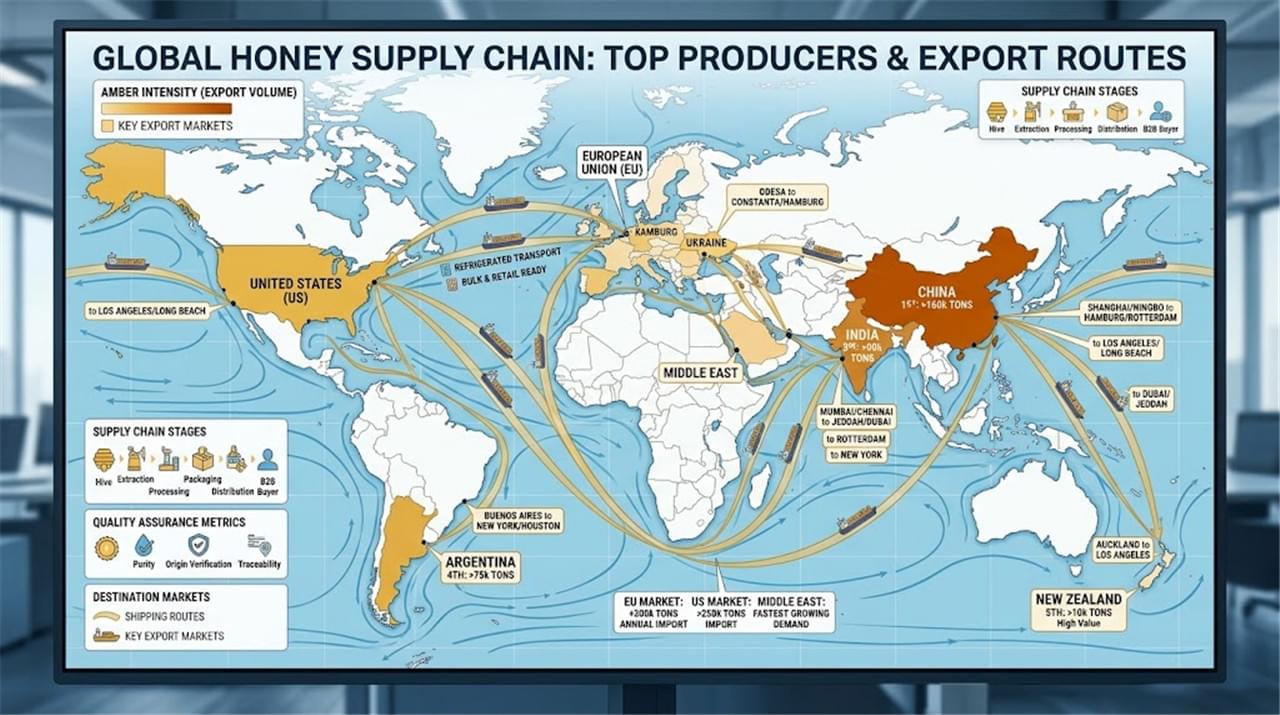
In 2022, the EU imported 363,000 tons of honey worth over €1.24 billion, making it the world’s largest importer. While volumes grew modestly at 0.5% annually (2018–2022), the value surged 5.8% yearly due to rising prices and supply concerns.
Approximately 49% of these imports—valued at €613 million—came from developing countries. The demand for imports spiked 32% between 2021 and 2022, largely because of low domestic production and growing consumer interest in high-quality and organic honey.
| Year | Import Value (Billion EUR) |
| 2018 | 10 |
| 2019 | 10.5 |
| 2020 | 11 |
| 2021 | 11.5 |
| 2022 | 12.4 |
Top Honey Importers and Global Suppliers
Germany leads the pack, accounting for 21% of Europe’s honey import volume and 23% by value. Other key markets include the UK, France, Belgium, and Poland.
China remains the EU’s largest supplier, providing 31% of total value and 28% of total volume. Ukraine, Argentina, Mexico, and Brazil are also major exporters. However, conflict in Ukraine and Mexico’s shift to new markets like the U.S. have opened supply gaps.
| Year | Import from Developing (Million EUR) |
| 2018 | 450 |
| 2019 | 480 |
| 2020 | 520 |
| 2021 | 465 |
| 2022 | 613 |
Growing Opportunities for Emerging Exporters
These supply changes offer space for emerging exporters, especially from Africa. Countries like Tanzania and Burkina Faso saw significant growth—averaging 8% and 42% annual increases in export value from 2018 to 2022.
To access the Europe honey market, exporters must: – Ensure honey purity and avoid adulteration. – Acquire organic certification to enter the growing European organic honey demand segment. – Comply with EU standards for sustainability and traceability.
| Country | Import Volume (%) | Import Value (%) | Notes |
| Germany | 21 | 23 | Largest EU importer; strong re-exporter |
| UK | 14 | 9.8 | Large market, price-sensitive |
| France | 10 | 11 | Growing organic demand |
| Belgium | 11 | 7.9 | Processes & re-exports honey |
| Poland | 5 | 6 | Fast-growing Eastern European demand |
Overcoming Market Challenges
The EU market demands transparency and quality. Following multiple food fraud scandals, European buyers prioritize authenticity. Honey that appears unusually cheap is often distrusted.
Analytical testing, full traceability, and ethical sourcing are becoming the norm. While Europe pays premium prices, exporters must prove their product meets expectations.
Organic Honey: A Niche with Strong Growth
Europe is the world’s largest organic food market. Countries like Germany, France, and the Netherlands are leading the charge in retail sales of organic honey.
Exporters that supply certified organic honey, and adhere to EU honey import trends, have a competitive edge—particularly those that can ensure consistent, sustainable sourcing.
Why Exporters Should Act Now
The Europe honey market is a high-growth, high-potential destination for honey exporters. The supply-demand gap, combined with consumer demand for natural and traceable products, makes now the ideal time to enter the market.
Those who invest in certification, build trusted supply chains, and commit to sustainability will be best positioned to thrive in this competitive but rewarding market.
Frequently Asked Questions (FAQ)
Q1: What types of honey are most in demand in the Europe honey market?
Natural, organic, and single-origin honeys are especially popular, driven by the growing European organic honey demand and health-conscious consumers.
Q2: What certifications do I need to export honey to Europe?
To succeed in honey export to Europe, you’ll need HACCP or equivalent food safety certifications, organic certification for the organic segment, and full product traceability.
Q3: What are the main challenges in accessing the Europe honey market?
The biggest obstacles include strict EU honey import regulations, growing concern over adulteration, and the need for consistent quality and documentation.
Q4: Which countries are gaining momentum in honey exports to Europe?
Aside from top players like China and Ukraine, emerging markets such as Tanzania and Burkina Faso are showing strong growth in EU honey import trends.
Q5: How can I stay competitive as a honey supplier to Europe?
Prioritize purity, meet certification standards, build transparent supply chains, and offer sustainable practices to meet European buyer expectations.
 English
 Arabic
 French
 German
 Portuguese
 Russian
 Spanish
 Japanese
 Korean