
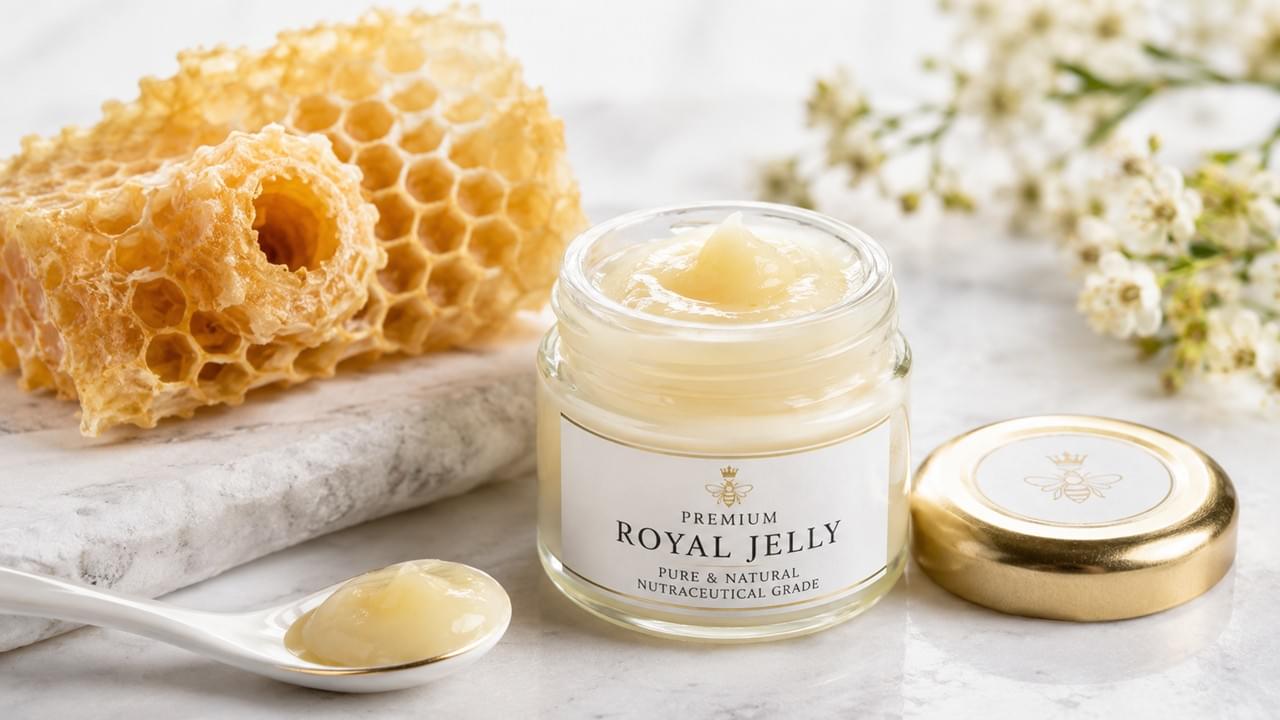
Royal jelly remains one of the most fascinating and valuable ingredients in the global bee products industry. As a premium Royal Jelly Nutraceutical ingredient, it attracts growing attention from supplement manufacturers, functional food brands, and cosmetic companies seeking scientifically supported natural ingredients.
Unlike honey, bee pollen, or propolis, royal jelly is produced in extremely limited quantities and requires intensive labor to harvest. Its unique composition, highlighted by the presence of 10-HDA and specialized proteins, has positioned it as a high-value ingredient in both nutritional and beauty markets.
For companies evaluating a royal jelly supplement ingredient, understanding quality standards, biological characteristics, and sourcing requirements is essential for making informed procurement decisions.
🐝 What Makes Royal Jelly Nutraceutical Products Unique?
Royal jelly is a nutrient-rich secretion produced by the hypopharyngeal and mandibular glands of young nurse bees, typically between 7 and 12 days old.
Every bee larva receives royal jelly during its first few days of development. However, only the future queen bee continues consuming royal jelly throughout her entire life. This exclusive diet contributes to remarkable physiological differences between queen bees and worker bees.
A queen bee can live for several years and produce thousands of eggs daily, while worker bees generally survive only a few weeks during active seasons. These extraordinary biological differences have made royal jelly a significant subject of scientific investigation for decades.
Commercial Production Process
Commercial royal jelly production involves carefully managed queen-rearing operations. Beekeepers transfer young larvae into artificial queen cells, encouraging nurse bees to deposit royal jelly.
Approximately 72 hours later, the queen cells are harvested, and the royal jelly is manually extracted.
📌 Typical production yields range from 400 to 600 grams per hive per season under optimal conditions, highlighting the ingredient’s scarcity and premium market value.
🔬 Royal Jelly Nutraceutical Composition: Understanding the Active Components
The nutritional profile of royal jelly is considerably more complex than many other bee-derived ingredients.
| Component | Typical Range |
|---|---|
| Water | 60–70% |
| Proteins | 12–15% |
| Sugars | 10–12% |
| Lipids | 4–8% |
| Minerals | 0.8–1.5% |
| Vitamins | Trace–Moderate |
Its combination of proteins, fatty acids, vitamins, minerals, and bioactive compounds forms the foundation of its nutraceutical appeal.
Royal Jelly Nutraceutical Proteins (MRJPs)
Among its most notable constituents are the Major Royal Jelly Proteins (MRJPs).
Researchers have identified nine major protein fractions, designated MRJP1 through MRJP9. Together, these proteins account for approximately 80–90% of the total protein content.
MRJP1 is the dominant protein and is frequently highlighted in scientific studies evaluating royal jelly’s biological activity.
Because these proteins are largely unique to royal jelly, they help support premium positioning within the global nutraceutical marketplace.
⭐ Royal Jelly Nutraceutical Quality Marker: Why 10-HDA Matters
One of the most important indicators of royal jelly quality is 10-Hydroxy-2-Decenoic Acid (10-HDA).
This fatty acid is considered unique to royal jelly and is widely used as both an authenticity marker and a quality benchmark.
Common 10-HDA Quality Standards
| Grade | 10-HDA Content |
|---|---|
| Standard Commercial | ≥1.4% |
| Premium Grade | 1.8–2.2% |
| High-End Grade | >2.0% |
| Freeze-Dried Royal Jelly | ≥4.0% |
Higher 10-HDA levels generally indicate stronger raw material quality and greater market value.
Scientific research has explored the role of 10-HDA in areas such as anti-inflammatory activity, cellular protection, neurological support, and antioxidant mechanisms. While many findings remain preclinical, they contribute significantly to the ingredient’s market attractiveness.
For additional scientific information, readers may review the research available through the Royal jelly bioactive compounds review:
https://www.ncbi.nlm.nih.gov/pmc/articles/PMC3312636/
🧪 Royal Jelly Nutraceutical Research and Verified Bioactivities
Interest in royal jelly continues to expand due to its broad range of investigated biological activities.
Current research has examined:
- ✅ Anti-inflammatory effects
- ✅ Antioxidant activity
- ✅ Neuroprotective potential
- ✅ Estrogen-like biological interactions
- ✅ Wound-healing support
- ✅ Antimicrobial properties
Several compounds, including MRJPs, royalisin, and 10-HDA, are believed to contribute to these observed effects.
However, manufacturers should carefully review local regulations before making health-related marketing claims. Most jurisdictions permit only general structure-function claims rather than disease-treatment claims.
📦 Royal Jelly Nutraceutical Applications Across Industries
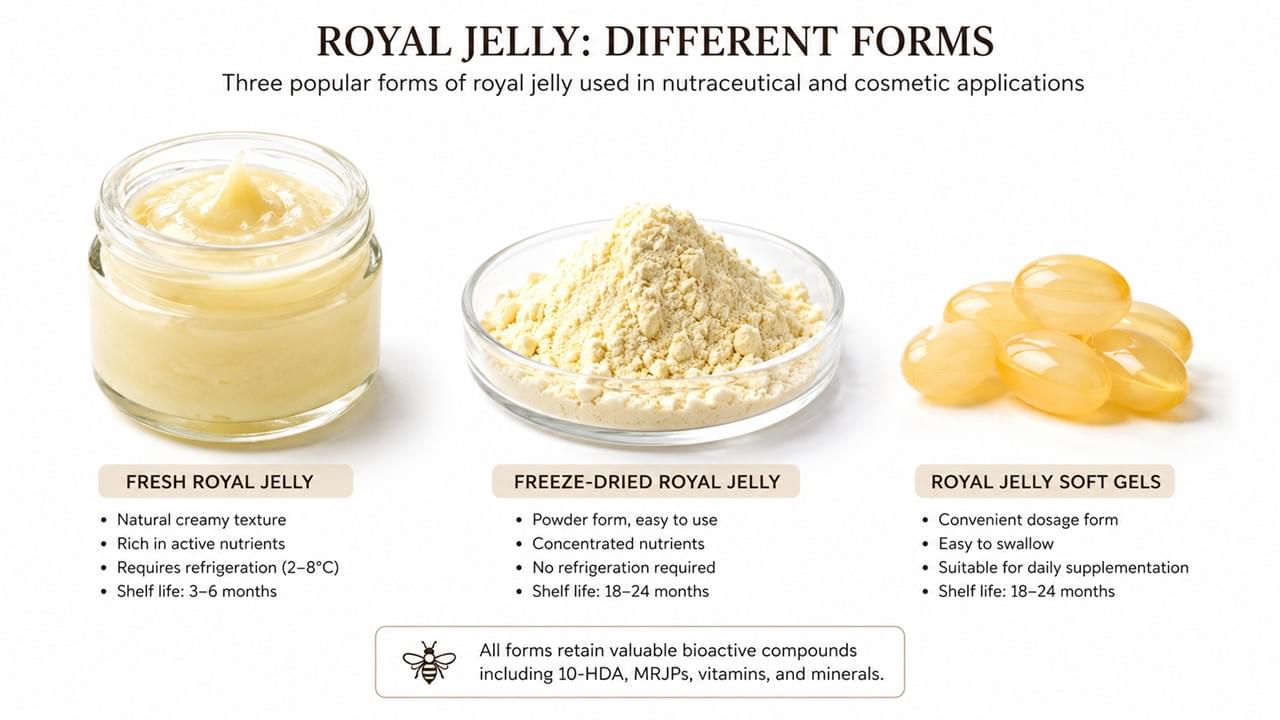
The commercial versatility of royal jelly has enabled its adoption across multiple product categories.
Fresh Royal Jelly
Fresh royal jelly remains highly popular in many Asian markets.
Characteristics include:
- Refrigerated or frozen storage
- Premium consumer perception
- Direct consumption applications
- Limited shelf-life without cold chain support
Freeze-Dried Royal Jelly
Freeze-dried royal jelly is increasingly preferred in international trade due to its improved stability and logistics advantages.
Benefits include:
- Moisture content below 5%
- Enhanced shelf stability
- Easier transportation
- Compatibility with supplement manufacturing
Dietary Supplement Applications
Royal jelly is commonly incorporated into:
💊 Capsules
💊 Softgels
💊 Tablets
💊 Powder blends
💊 Functional beverage formulations
Japan remains one of the world’s largest markets for royal jelly-based dietary supplements.
Cosmetic Applications
Royal jelly is also widely utilized in premium skincare products.
Popular applications include:
✨ Anti-aging creams
✨ Facial serums
✨ Sheet masks
✨ Skin nourishment products
Its naturally occurring proteins and bioactive compounds contribute to strong consumer appeal in beauty formulations.
🚚 Royal Jelly Nutraceutical Procurement Guide for B2B Buyers
Selecting a reliable bulk royal jelly supplier requires more than evaluating price alone.
Quality assurance, traceability, and compliance documentation should play a central role in supplier selection.
Documentation Checklist
B2B buyers should request:
✔ Certificate of Analysis (CoA)
✔ 10-HDA verification report
✔ Microbiological testing results
✔ Heavy metal analysis
✔ Pesticide residue screening
✔ Product authenticity verification
These documents provide essential evidence of product quality and regulatory compliance.
Cold Chain Requirements
For fresh royal jelly products, temperature control is critical.
Recommended standards include:
❄ Storage at -18°C for long-term preservation
❄ Refrigerated distribution between 0–4°C
❄ Continuous temperature monitoring throughout transportation
For freeze-dried products, room-temperature storage is generally acceptable when moisture-proof packaging is used.
🌍 Building a Sustainable Royal Jelly Supply Strategy
As consumer demand for natural health ingredients continues to expand, royal jelly is expected to remain a premium component within the global nutraceutical sector.
Companies seeking long-term success should prioritize suppliers capable of delivering:
- Consistent 10-HDA levels
- Reliable cold-chain management
- Full regulatory documentation
- Scalable production capacity
- Transparent sourcing practices
Buyers interested in broader bee product procurement strategies may also explore our Bee Products Complete Guide, Health and Nutritional Impacts Guide, Global Sourcing Guide, and Quality Standards and Certifications resources to better understand the wider bee-products market.
For businesses seeking fresh frozen or freeze-dried royal jelly, working with an experienced sourcing partner can significantly reduce quality risks while supporting long-term product development goals.



 English
 Arabic
 French
 German
 Portuguese
 Russian
 Spanish
 Japanese
 Korean